WhatsApp: +86 199 2880 2613
Lingerie Manufacturing Guides
How to Source Custom Lingerie & Shapewear: A B2B Procurement Guide
Custom lingerie and shapewear sourcing guide: OEM vs ODM, tech-pack requirements, MOQ, sampling, material compliance and AQL 2.5 quality control.
Quick answer for procurement teams
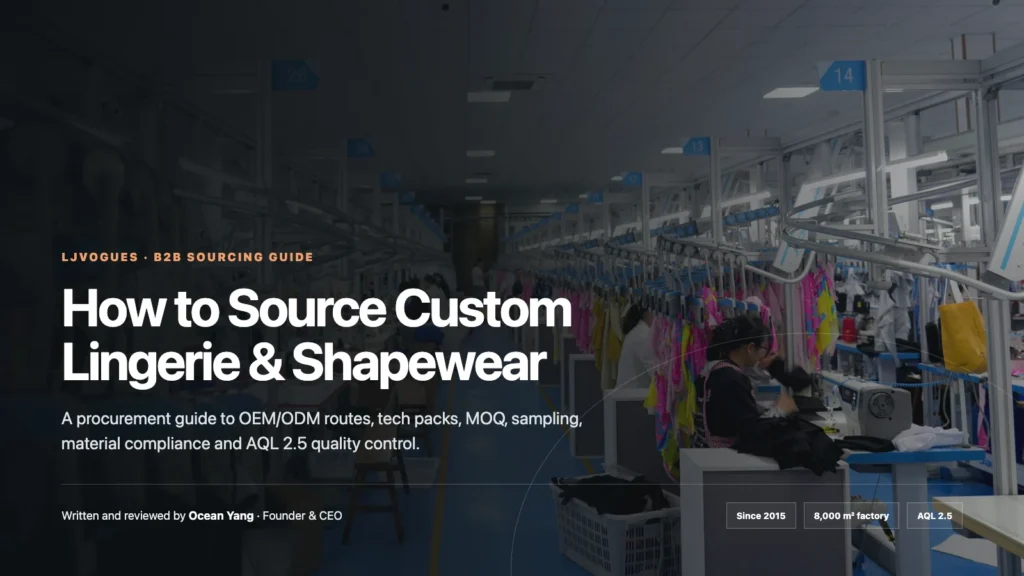
Start with the commercial route, not a catalogue. Confirm OEM or ODM, build a complete tech pack, approve materials and a physical sample, then use the sealed golden sample and AQL 2.5 acceptance standard for bulk production. For Ljvogues, ready-stock styles start from 50 pcs, custom styles from 300 pcs per style and color, custom sampling takes 7–10 days after confirmation, and bulk production is typically 25–45 days.
Sourcing custom lingerie is part fit development, part material engineering and part supply-chain risk management. A factory can make a beautiful first sample and still be the wrong partner if it cannot repeat the fit, document the materials or control production consistently.
This guide is written for brand owners, private-label teams, e-commerce operators and importers comparing bras, panties, period panties and shapewear. It focuses on the information a factory actually needs to quote, sample and produce—and the questions buyers should ask before paying a deposit.
1. Choose the right cooperation model: OEM vs ODM
OEM and ODM are not simply two price levels. They describe how much development responsibility sits with your team and how much sits with the factory.
| Decision | OEM | ODM |
|---|---|---|
| Best for | Brands with a defined design, tech pack, size grade and material specification | Brands that want to start from a proven construction and shorten development time |
| Your input | Technical drawings, measurements, BOM, construction and branding requirements | Reference style, target market, price point, fit direction and customization brief |
| Factory role | Review feasibility, source or confirm materials, develop samples and produce to specification | Recommend an existing base, adapt materials or trims, develop fit and apply private-label branding |
| Main risk to manage | Incomplete or contradictory technical specifications | Assuming a base style can meet every fit, support or price requirement without changes |
If you already have a complete tech pack, ask for an OEM feasibility review before quotation. If you are still defining the product, ask the factory to shortlist ODM constructions that match the intended support, coverage, fabric and cost.
For a detailed comparison, see our OEM/ODM lingerie manufacturing services.
2. Build a tech pack the factory can actually quote and sample
A tech pack is not only a sketch. It is the shared production definition that connects design, pattern making, material purchasing, sampling and quality control. Missing information usually returns as an extra sampling round, a cost change or a dispute during bulk inspection.
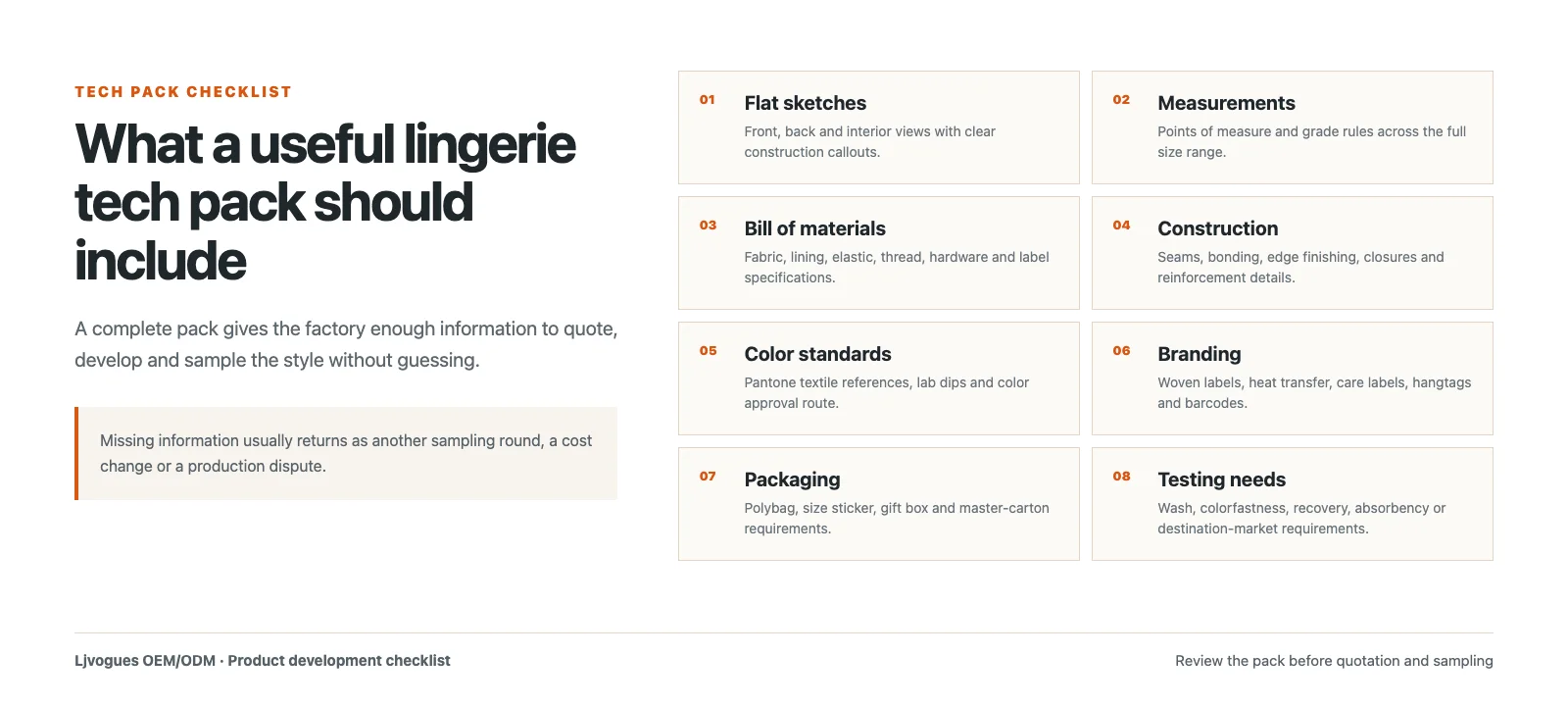
At minimum, include:
Flat sketchesFront, back and interior views with stitch, seam, bonding, edge-finishing and closure callouts.
Points of measureMeasurement points, tolerances and grade rules from XS through the largest requested size.
Bill of materialsShell fabric, lining, gusset, elastic, thread, hardware, labels and packaging with approved references.
Color standardsPantone textile references, lab-dip approval route and colorways per size or style.
Construction detailsSeam type, bonding method, edge tension, reinforcement and any functional layers.
Commercial contextTarget quantity, size curve, delivery date, target FOB and destination-market requirements.
If you only have a physical reference sample, ask whether the factory can reverse-engineer the construction and create a working tech pack. This is possible, but the approved sample and written specification still need to be completed before bulk production.
3. Agree MOQ, sampling and bulk lead times before design work
MOQ should be discussed together with materials, colors, size assortment and packaging. A low headline MOQ can become expensive if it requires special fabric dyeing, custom moulds or separate packaging runs.
| Commercial point | Typical starting benchmark | What to confirm in writing |
|---|---|---|
| Ready-stock MOQ | From 50 pcs | Available colors, sizes, current stock and mixed-size rules |
| Custom style MOQ | From 300 pcs per style and color | Color count, size curve, material availability and branding method |
| Custom fabric MOQ | Usually 500–1,000 pcs depending on the mill and color | Minimum dye lot, lead time, surcharge and testing requirements |
| Stock sample | Usually within 72 hours | Sample availability and freight cost |
| Custom sample | Usually 7–10 days after tech pack and fabric confirmation | Sample fee, revision policy and refund conditions after bulk order |
| Bulk production | Typically 25–45 days after sample approval and deposit | Material lead time, capacity booking, inspection date and shipping terms |
These are practical starting points, not universal promises. The final quotation should state the exact quantity, materials, colorways, branding, packaging, Incoterm, payment terms and delivery window for your order.
Procurement note
Do not compare two factory quotations unless the tech pack, fabric, trims, size curve, packaging and Incoterm are the same. Otherwise you are comparing different products.
4. Review materials, testing and compliance at the right level
Intimate apparel has prolonged skin contact, so material selection and documentation matter. Ask for certification that matches the actual fabric, construction and destination market—not a generic certificate covering an unrelated material.
- Fabric and recovery: confirm composition, weight, stretch, recovery, shrinkage and hand-feel before lab dipping.
- Skin-safety documentation: request OEKO-TEX Standard 100 or other relevant reports for the exact materials used.
- Organic or recycled claims: verify the certificate scope, transaction certificates and chain-of-custody requirements before using claims in product listings.
- Performance testing: agree colorfastness, wash, pilling, stretch recovery or absorbency testing where relevant to the product and market.
Ljvogues works with documented material suppliers and can provide OEKO-TEX certificate 26.HCN.12213 and GOTS license GOTS-BVCN9928 for review where the scope matches the order. BSCI audit documentation is also available for buyer review.
For period panties, absorbency and leak-protection claims should be tested against the exact finished construction. Fabric safety alone does not prove functional performance.
5. Approve the sample as a production standard, not just a fit sample
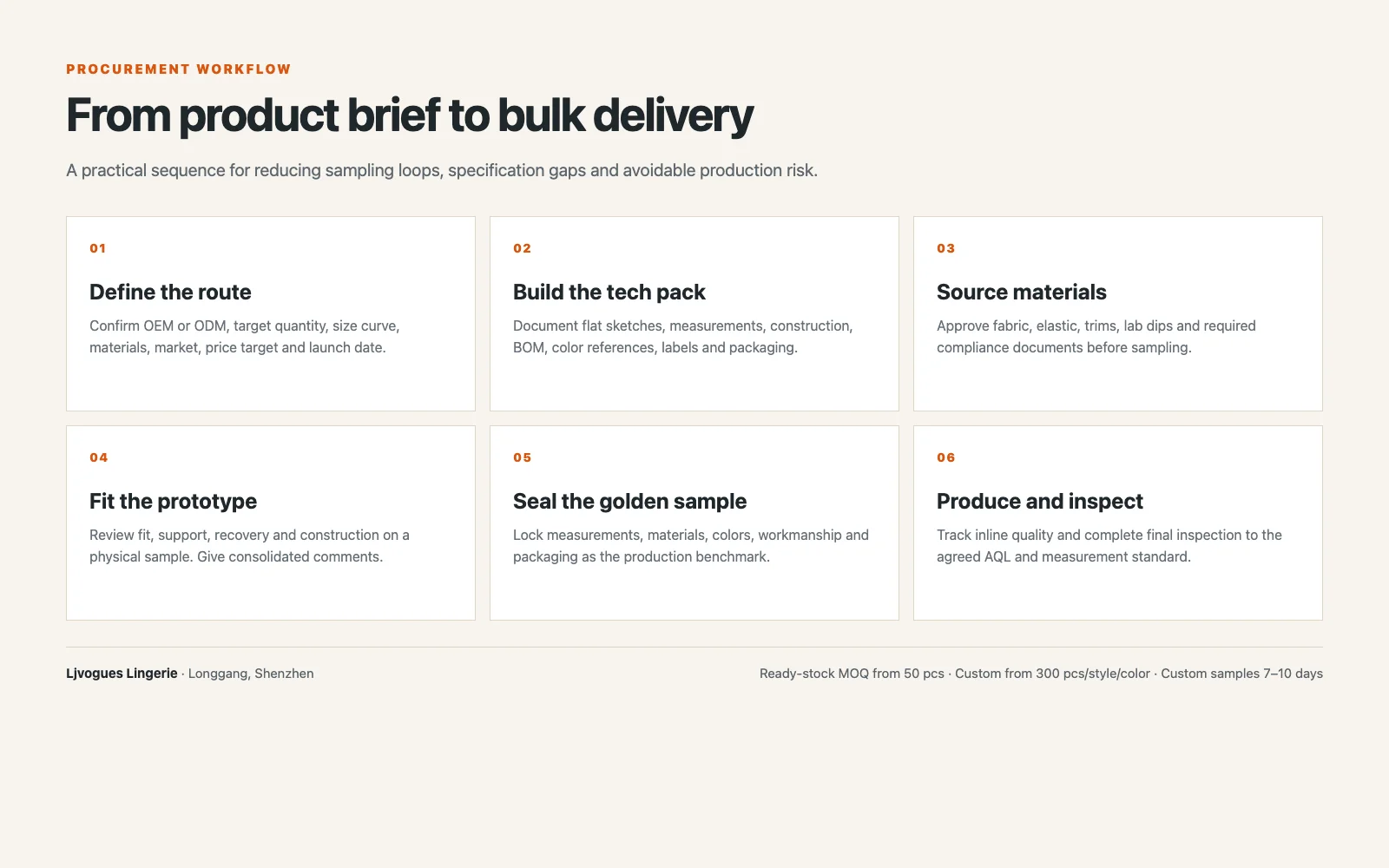
A useful sample review covers more than whether the garment looks right on one model. Check the sample against the tech pack and record comments by category:
- Fit: cup coverage, underband tension, strap placement, rise, gusset position, compression or comfort.
- Measurements: compare the physical sample with the requested points of measure and grade rules.
- Materials: confirm fabric, lining, elastic, trims, color and hand-feel against approved references.
- Construction: inspect seams, bonding, edge finish, closures, reinforcement and workmanship.
- Branding and packaging: approve label placement, care label, hangtag, polybag, barcode and carton marks.
After approval, seal a golden sample. It becomes the benchmark for bulk measurements, materials, color and workmanship. Keep the approved comments and photographs with the purchase order so the factory and buyer are working from the same record.
6. Control quality with defined checks and AQL acceptance criteria
Quality control should begin before cutting and continue through packing. A practical program includes incoming material inspection, inline checks and final random inspection.
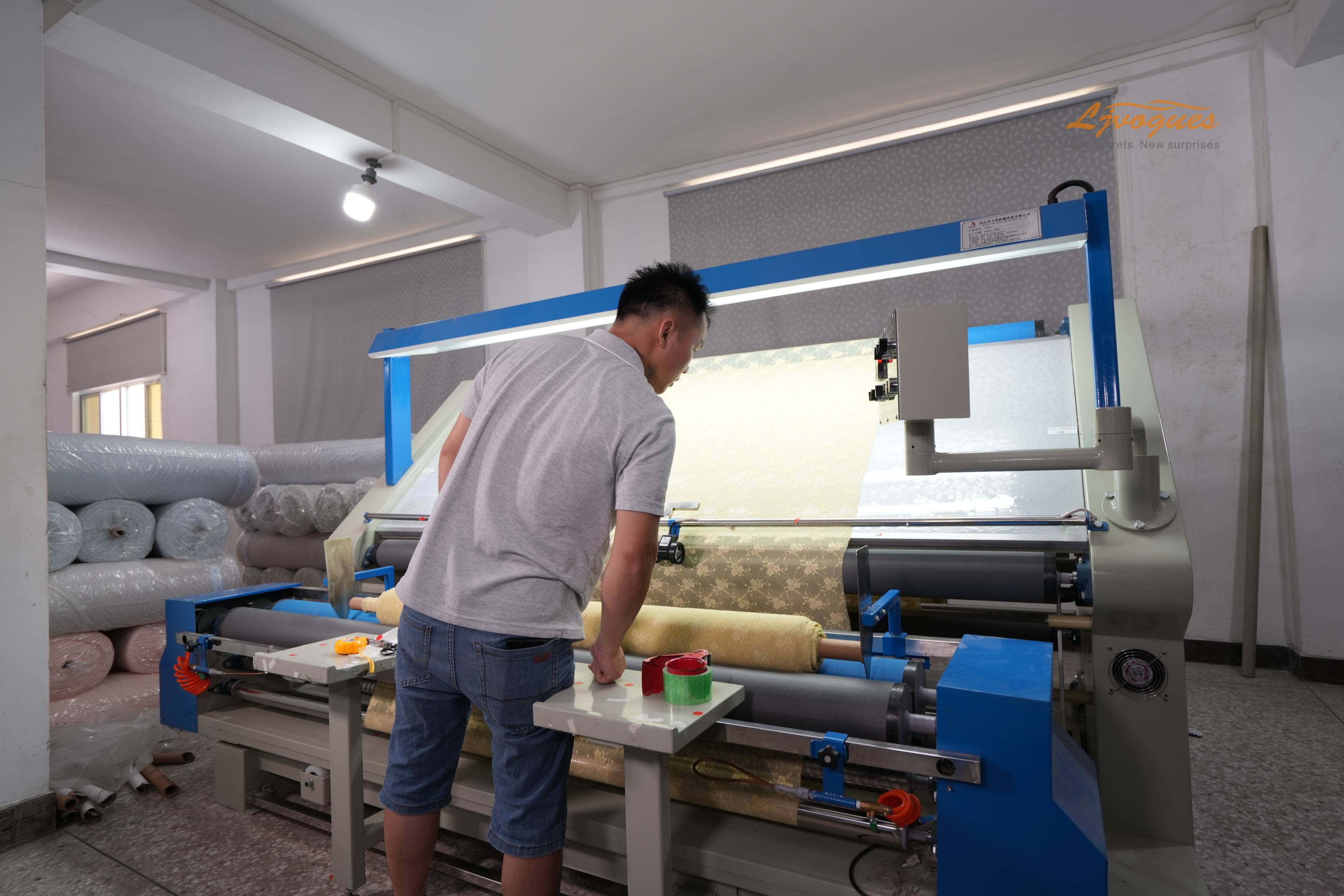
For bulk inspection, agree the sampling plan, defect definitions and measurement tolerances in advance. Ljvogues uses AQL 2.5 for major defects and AQL 1.0 for critical defects, with inspection records available for review.
Typical inspection points include:
- Fabric shade, weight, width, shrinkage and visible defects
- Measurement verification against the sealed sample
- Stitch density, seam strength, bonding and edge recovery
- Elastic tension, hardware security and closure function
- Label placement, packing count, barcode and carton marks
Ask how defects are classified, who performs the inspection, what evidence is supplied and what happens if the lot fails. A clear rejection and correction process is more useful than a general promise of “strict quality control.”
7. Compare factories on execution, not just unit price
Use a short scorecard before moving to sampling. A factory that answers quickly but cannot show its sampling, material and inspection process creates more risk later.
Technical responseDoes the factory identify construction risks, measurement gaps and material questions before quoting?
Sampling controlAre sample lead time, revision rounds, approval records and golden-sample sealing defined?
Material traceabilityCan the factory match certificates and test reports to the actual fabric and trim used?
Production evidenceCan it show the factory floor, machinery, QC process and capacity relevant to your category?
CommunicationIs there one accountable contact who consolidates technical and commercial answers?
Reorder reliabilityWill the fabric, pattern, color standard and approved sample be retained for future orders?
Ljvogues has operated from Longgang, Shenzhen since 2015. The factory covers 8,000 m², employs 200+ people and supports monthly capacity of 500,000+ pieces, with a team of English-speaking trade specialists coordinating development and production. Buyers can review the factory, equipment and quality-control process before placing an order.
8. Category-specific questions for bras, panties, period panties and shapewear
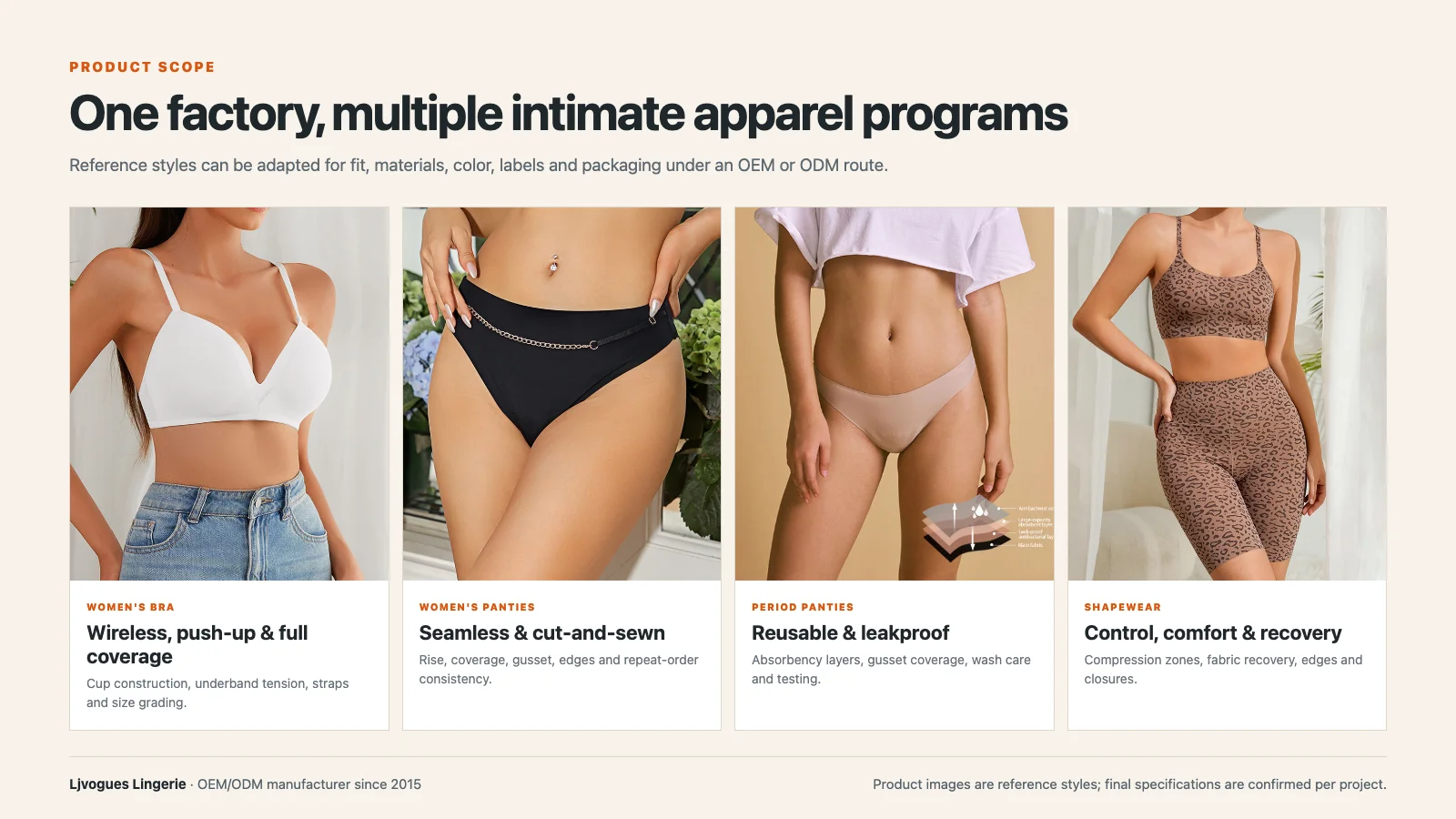
Custom bras
Confirm cup construction, underband tension, strap placement, wire or wireless support and grading. Ask how the factory will fit-test the full size range rather than approving one sample size. Explore custom bra manufacturing.
Women’s panties
Review rise, coverage, gusset construction, leg-opening finish and waistband recovery. Small pattern changes can significantly affect comfort and return rates. Explore private-label panties.
Period panties
Define the absorbency layer, waterproof backing, gusset coverage, wash-care requirements and testing plan before discussing claims. The functional system must be validated as a complete construction. Explore OEM period panties.
Shapewear
Balance compression, recovery, edge pressure and closure comfort. Ask how the factory will adjust panels or fabric without losing the intended outer design. Explore custom shapewear manufacturing.
Common sourcing mistakes to avoid
- Requesting a quotation without a tech pack or reference sample
- Comparing prices without matching materials, trims, sizes and packaging
- Approving a sample without recording measurements and revision comments
- Accepting a certificate without checking the material and certificate scope
- Leaving inspection criteria, defect definitions and Incoterms until after production
- Choosing a factory only on sample quality without checking bulk capacity and reorder control
FAQ: custom lingerie and shapewear sourcing
What is the MOQ for custom lingerie and shapewear?
At Ljvogues, ready-stock styles can start from 50 pcs. Custom styles typically start at 300 pcs per style and color. Custom fabric development usually starts at 500–1,000 pcs depending on the mill and color. The quotation should confirm the exact quantity, material and packaging route.
How long does sampling and bulk production take?
Stock samples are usually available within 72 hours. Custom sampling typically takes 7–10 days after the tech pack and fabric are confirmed. Bulk production is normally 25–45 days after golden-sample approval and deposit, depending on materials, capacity and order complexity.
Can a factory develop a style from a reference sample without a tech pack?
Yes. A factory can reverse-engineer the construction and develop a working tech pack from a physical reference sample. The buyer should still approve measurements, materials, construction, colors, branding and packaging before sealing the golden sample.
Which certificates should a lingerie buyer request?
Request documentation that matches the exact fabric, trim, construction and destination market. Common requests include OEKO-TEX Standard 100, GOTS or recycled-material certificates, BSCI audit documentation, colorfastness and wash reports, and product-specific functional testing such as absorbency or leak performance where relevant.
What quality standard should be agreed before bulk production?
Agree the inspection plan, defect definitions, measurement tolerances and acceptance level in writing. Ljvogues uses AQL 2.5 for major defects and AQL 1.0 for critical defects, supported by material inspection, inline checks and final random inspection.
Planning a new bra, panty, period panty or shapewear program?
Send your reference styles, target quantity, material direction, size range and market. Our team will review the most practical OEM or ODM route and recommend the next step for sampling and quotation.
Reviewed by Ocean Yang, Founder & CEO of Ljvogues. This guide reflects the factory’s current sampling and production workflow as of October 2026. Final MOQ, lead times, testing requirements and commercial terms are confirmed in the quotation and proforma invoice for each order.

Ocean Yang
Founder & CEO | LjvoguesOcean Yang is the founder and CEO of Ljvogues. He writes about intimate apparel sourcing, material selection, fit development and factory quality control.
Read the full author profile →Related articles
Eco-Friendly Lingerie Manufacturing: Sustainable Materials & OEM/ODM Best Practices
Sustainable lingerie manufacturing guide: compare recycled nylon, organic cotton, OEKO-TEX, GRS/GOTS documentation, durability and OEM/ODM production.
By Ocean Yang - Read article →
Designing and Manufacturing Modern Shapewear: Balancing Comfort and Compression
Engineer shapewear and soft contour wear with balanced compression, fabric recovery, bonded edges, fit grading, sampling and OEM/ODM quality control.
By Ocean Yang - Read article →
Minimizing Defect Rates in Lingerie Mass Production: A Quality Control Guide
Reduce lingerie production defects with incoming material checks, inline QC, AQL 2.5 inspection, defect classification and corrective action.
By Ocean Yang - Read article →