WhatsApp: +86 199 2880 2613

Lingerie Manufacturing Guides
Minimizing Defect Rates in Lingerie Mass Production: A Quality Control Guide
Reduce lingerie production defects with incoming material checks, inline QC, AQL 2.5 inspection, defect classification and corrective action.
Quick answer for procurement teams
Defect control in lingerie production works best as a three-stage system: verify incoming materials, monitor production inline and make the final acceptance decision with an agreed AQL standard. Ljvogues uses AQL 2.5 for major defects and AQL 1.0 for critical defects, supported by the sealed golden sample, measurement tolerances, defect definitions and corrective-action records.
Lingerie quality problems are rarely caused by one dramatic failure. More often, they come from a chain of small inconsistencies: a fabric width change, an elastic lot with different recovery, a pattern marker that shifted, a bonding temperature that drifted or a measurement tolerance that was never agreed.
The earlier those issues are detected, the cheaper they are to correct. A final inspection can stop a bad lot from shipping, but it cannot recover the materials, labour and delivery time already spent.
1. Where defect risk begins in lingerie production
Intimate apparel combines close fit, high-stretch materials, skin contact and small trim details. That creates quality risks that are different from outerwear.
- Fabric weight, width, shade or stretch recovery may vary by lot.
- Elastic tension may change after sewing, bonding or washing.
- Lace and mesh can distort when cut, joined or stretched.
- Bonded edges may peel, bubble or fail if temperature and pressure are not controlled.
- Measurement drift can appear after the first size or first production shift.
- Labels, care text, barcodes or carton marks may be wrong even when the garment itself is acceptable.
For buyers, the practical question is not “How many inspectors does the factory have?” It is whether the factory has a defined standard, checks the right points and records what happens when a result fails.
2. Build quality control around three stages
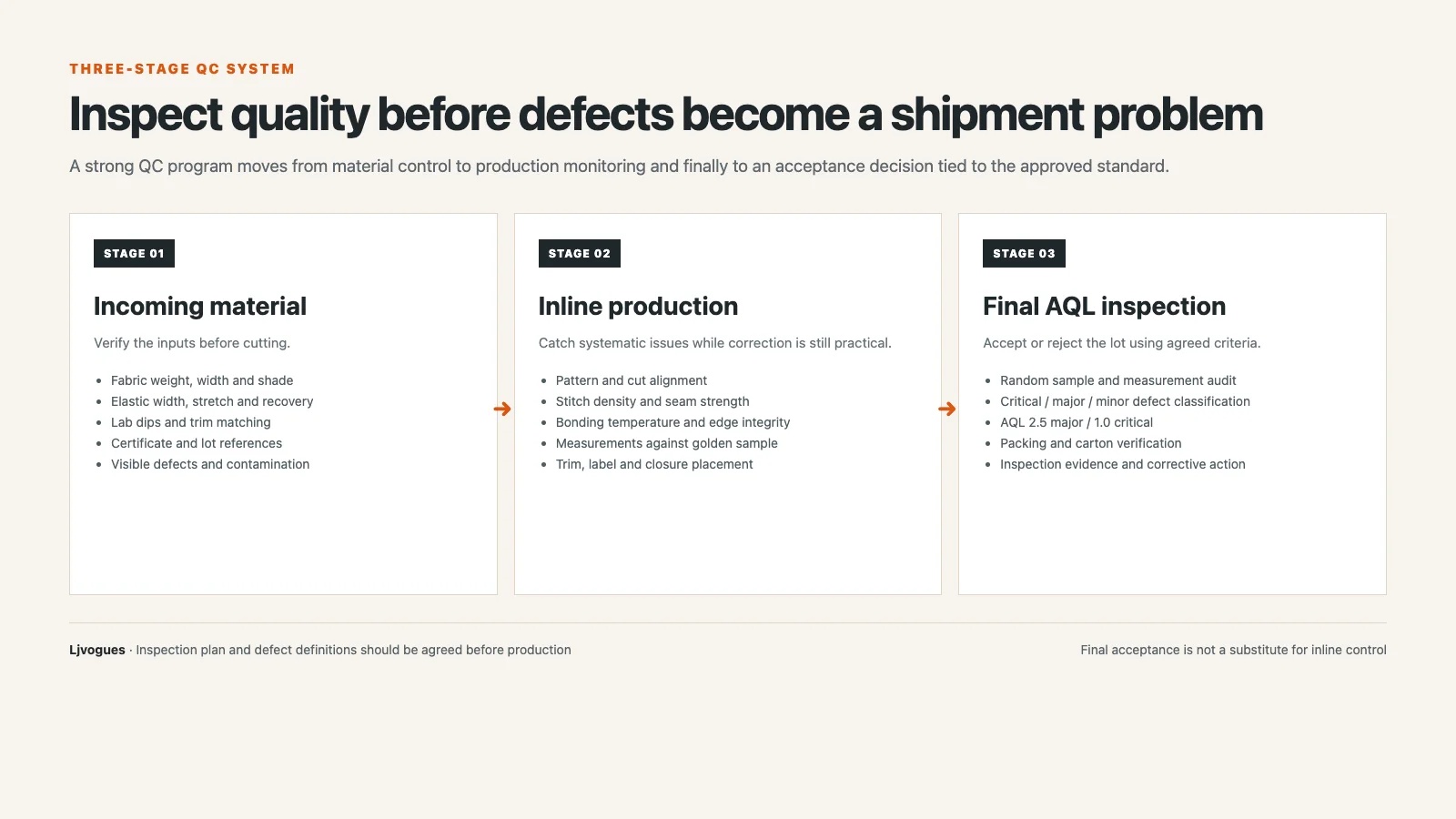
Stage one: incoming material inspection
Verify the inputs before cutting. This stage protects the factory from turning a material problem into hundreds of finished defects.
Stage two: inline production monitoring
Check the first output, then continue scheduled checks during cutting, sewing, bonding and finishing. Inline control is where systematic errors should be corrected.
Stage three: final random inspection
Inspect the completed lot against the approved sample, measurement tolerances, defect definitions and packing requirements. Final inspection confirms whether the lot should be accepted, reworked or rejected—it does not replace the previous two stages.
3. Incoming material checks that matter
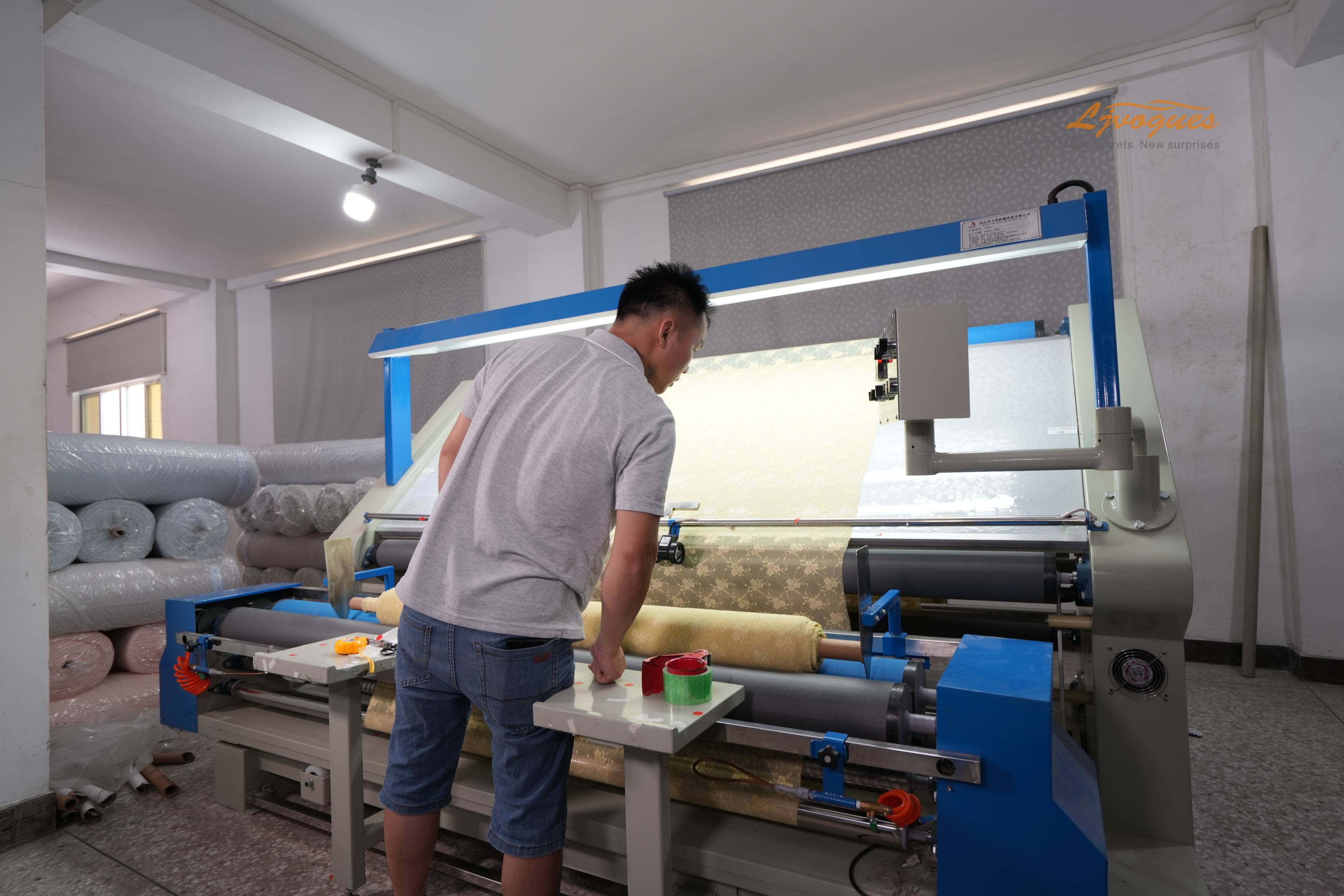
A useful incoming quality control record should include:
Fabric identityComposition, weight or GSM, width, construction and supplier reference against the approved bill of materials.
Shade and hand-feelColor standard, lot variation, surface appearance, softness and any visible defects.
Elastic and trim performanceWidth, thickness, elongation, recovery and color match for waistbands, underbands and straps.
Lab dipsApproved color reference and lighting conditions before bulk fabric or trim is released.
Shrinkage and stabilityRelevant wash or heat testing before cutting sensitive fabrics.
DocumentationCertificate scope, test reports, lot references and any buyer-approved deviations.
Not every material needs the same test. The inspection plan should focus on the risks of the specific fabric, construction and end use. A power-net used for shapewear requires different attention from a delicate lace trim or an absorbent period-panty layer.
4. Inline production control: catch systematic errors early
The first approved sample is the reference, but production consistency has to be checked while the line is running. Typical inline checks include:
- Pattern and marker alignment before cutting
- Cut-piece count, shade matching and ply consistency
- Stitch type, stitch density, seam strength and seam allowance
- Elastic tension, underband stretch and strap attachment
- Bonding temperature, pressure, dwell time and edge integrity
- Measurements against the approved size chart and tolerances
- Label, care-label, hardware and closure placement
- Cleanliness, contamination and damage prevention
Inline checks should be scheduled by risk, not treated as random visits. A new style, first production day, material change or new machine setting usually deserves closer monitoring than a stable repeat order.
5. Category-specific quality risks
Bras
Watch cup symmetry, underband tension, strap attachment, wire or wireless support, seam strength and grading across cup sizes. A bra that fits one sample size cannot be assumed to fit the full range.
Panties
Check rise, coverage, gusset position, leg-opening recovery and waistband tension. Small pattern or elastic changes can affect comfort and cause returns even when the garment looks acceptable.
Shapewear
Focus on compression consistency, fabric recovery, panel placement, seam pressure, edge rolling and closure performance. Compression and comfort must be evaluated on the body, not only on a flat table.
Period panties
Add functional-zone checks: layer alignment, barrier placement, gusset coverage, bonding integrity, wash durability and the agreed performance tests. A visual inspection alone cannot confirm absorbency or leak protection. For the technical construction and testing detail, read our period panty manufacturing guide.
6. Define critical, major and minor defects before production
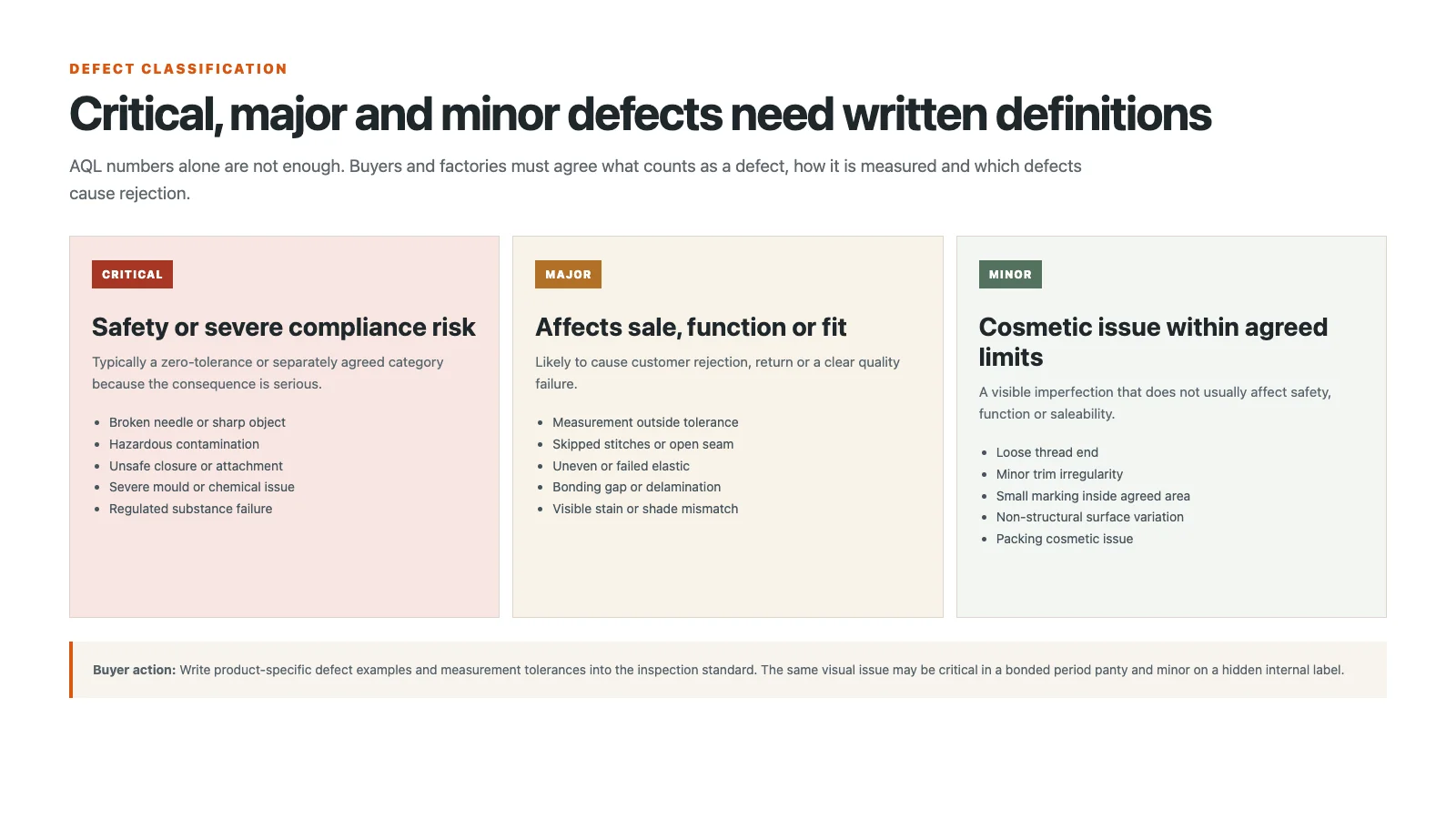
| Defect class | Typical effect | Examples to define |
|---|---|---|
| Critical | Safety, severe compliance or contamination risk | Broken needle, sharp object, hazardous contamination, unsafe closure or regulated substance failure. |
| Major | Affects function, fit, saleability or customer acceptance | Measurement outside tolerance, open seam, skipped stitches, failed bonding, uneven elastic, visible stain or shade mismatch. |
| Minor | Cosmetic issue within agreed limits | Loose thread, small trim irregularity or minor surface variation that does not affect safety, function or saleability. |
Ljvogues uses AQL 2.5 for major defects and AQL 1.0 for critical defects. The inspection plan should also define sample size, measurement points, defect codes, photos and the action taken when a lot fails.
What AQL does—and does not mean
AQL is an acceptance-sampling framework, not a promise that every unit is perfect. It helps the buyer and factory make a consistent lot decision based on a defined sample and defect classification. Inline control is still required to prevent defects from accumulating.
7. What to verify in final inspection
Final inspection should happen when the lot is complete enough to represent the shipment and packing method. Confirm the inspection standard and sampling plan in advance.
- Quantity and assortment: styles, colors, sizes and packing ratios match the purchase order.
- Measurements: random units meet the approved measurement chart and tolerance.
- Workmanship: seams, bonding, edges, elasticity, hardware and closures are inspected against the golden sample.
- Functional checks: any required stretch, recovery, absorbency or other performance test is evidenced.
- Branding and care: labels, logos, care text, country of origin and barcodes are correct.
- Packing: polybags, size stickers, cartons, carton marks and barcode scanning are verified.
- Inspection record: findings, photos, sample size, defect counts and release decision are documented.
8. When a defect is found, correct the cause
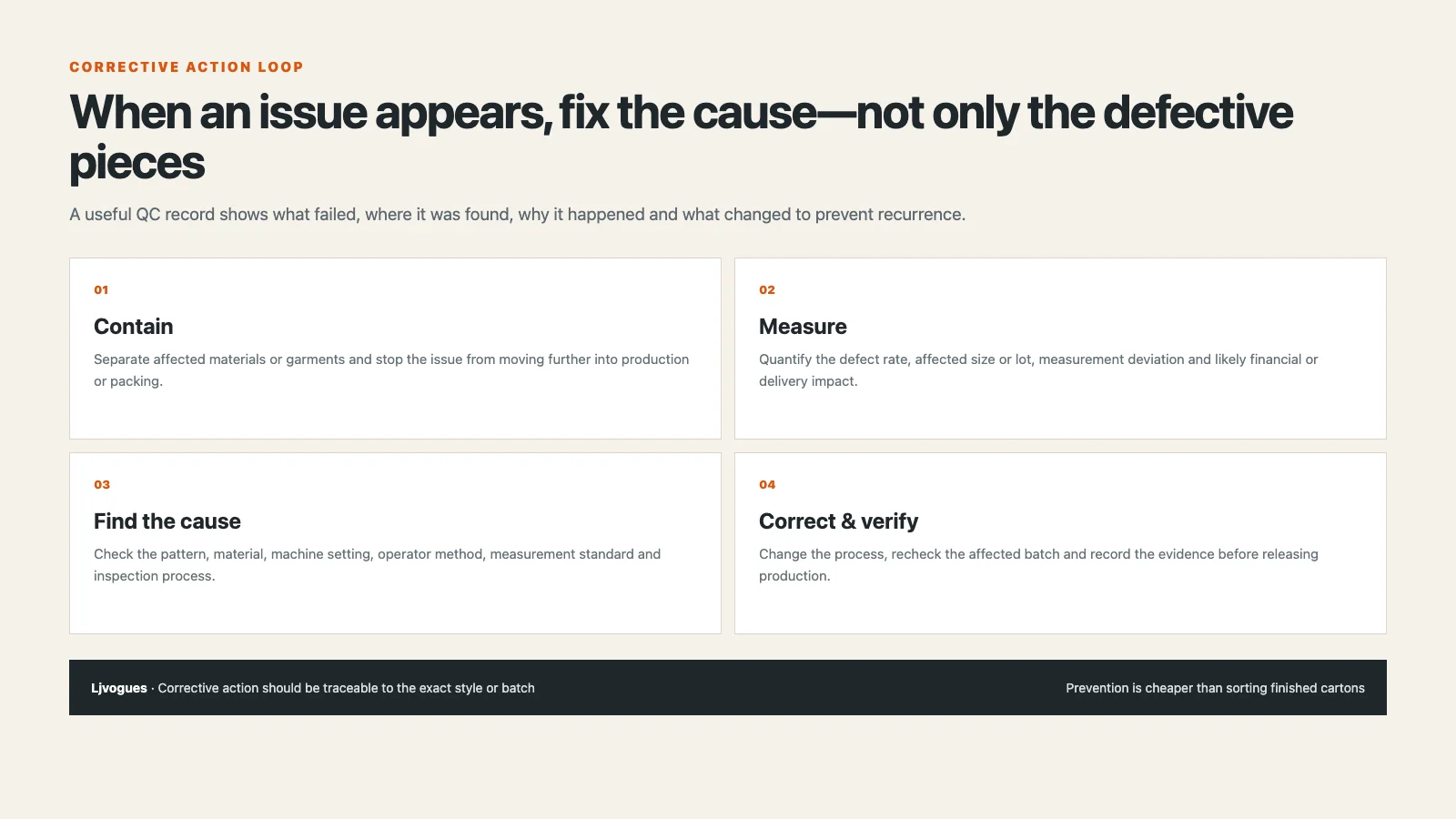
A useful corrective-action record answers four questions:
What is affected?Identify the style, material lot, size, production line and quantity.
How serious is it?Classify the defect, measure the rate and assess safety, delivery and commercial impact.
Why did it happen?Check the pattern, material, machine setting, operator method, measurement standard or inspection process.
What changed?Record the correction, re-inspection result and evidence that the batch is now acceptable.
This approach is more useful than a report that only lists defects. The buyer needs to know whether the problem was contained and whether the production process has changed enough to prevent recurrence.
9. Build the QC plan before production starts
A practical QC plan can be summarized in a pre-production checklist:
- Approved tech pack and final measurement chart
- Sealed golden sample with photos
- Approved bill of materials and color standards
- Written defect definitions and measurement tolerances
- Inspection stages, sampling plan and AQL levels
- Required testing and certificate scope
- Label, packaging and carton requirements
- Corrective-action and escalation contacts
For related guidance, read our lingerie tech pack guide, review our factory and quality process or explore OEM/ODM production services.
FAQ: lingerie quality control and AQL inspection
What AQL standard does Ljvogues use?
Ljvogues uses AQL 2.5 for major defects and AQL 1.0 for critical defects. The inspection plan, sample size, defect definitions and acceptance criteria are agreed for the specific product and order.
Does final inspection guarantee that every garment is perfect?
No. Final inspection is an acceptance-sampling process based on a defined sample and defect classification. It should be supported by incoming material inspection and inline production checks to prevent defects from accumulating.
How do you classify a critical, major or minor defect?
Critical defects involve safety, severe contamination or compliance risk. Major defects affect function, fit or saleability. Minor defects are controlled cosmetic issues within agreed limits. Product-specific examples should be written into the inspection standard before production.
Can buyers request third-party inspection?
Yes. Buyers can arrange an agreed third-party inspection or audit according to their own supplier requirements and the terms of the order. The factory and buyer should align on timing, access, sampling plan and release process in advance.
What should a buyer review in a quality inspection report?
Review the lot and sample identification, inspection date, quantities checked, measurement results, defect counts and classification, packing verification, photos, acceptance result and any corrective actions or re-inspection requirements.
Planning a production run with tighter QC?
Share your product category, tech pack, target quantity, approved sample stage and market requirements. Our team will help define the inspection and testing points before bulk production begins.
Reviewed by Ocean Yang, Founder & CEO of Ljvogues. This guide reflects current OEM/ODM inspection practice as of October 2026. Final inspection plans, defect definitions, testing and commercial terms are confirmed for the exact product and order.

Ocean Yang
Founder & CEO | LjvoguesOcean Yang is the founder and CEO of Ljvogues. He writes about intimate apparel sourcing, material selection, fit development and factory quality control.
Read the full author profile →Related articles
Eco-Friendly Lingerie Manufacturing: Sustainable Materials & OEM/ODM Best Practices
Sustainable lingerie manufacturing guide: compare recycled nylon, organic cotton, OEKO-TEX, GRS/GOTS documentation, durability and OEM/ODM production.
By Ocean Yang - Read article →
Designing and Manufacturing Modern Shapewear: Balancing Comfort and Compression
Engineer shapewear and soft contour wear with balanced compression, fabric recovery, bonded edges, fit grading, sampling and OEM/ODM quality control.
By Ocean Yang - Read article →
From Concept to Bulk Production: A Complete Guide to Lingerie Tech Packs
Build a production-ready lingerie tech pack: technical flats, BOM, measurements, construction, color standards, sampling feedback and bulk handoff.
By Ocean Yang - Read article →