WhatsApp: +86 199 2880 2613
Lingerie Manufacturing Guides
Eco-Friendly Lingerie Manufacturing: Sustainable Materials & OEM/ODM Best Practices
Sustainable lingerie manufacturing guide: compare recycled nylon, organic cotton, OEKO-TEX, GRS/GOTS documentation, durability and OEM/ODM production.
Quick answer for sustainable sourcing
Start with a specific material and a claim you can support. Verify the fibre composition, certificate scope, transaction records and finished-product applicability before using words such as “recycled,” “organic,” “biodegradable” or “sustainable.” Then test durability, comfort and recovery so the lower-impact choice still performs as underwear or shapewear.
“Sustainable lingerie” is not a single material or certificate. It is a set of decisions about fibre source, processing, durability, trims, packaging, care and end-of-life. Buyers need to separate what is verified, what is an improvement, and what is still an aspirational marketing claim.
That is especially important in intimate apparel, where the main fabric may be recycled while the elastic, lining, dye or packaging follows a different supply chain. A credible product claim should reflect the whole construction—not just one attractive component.
1. Build sustainability claims from evidence, not adjectives
Words such as “eco-friendly,” “green” and “sustainable” are broad. More useful claims name the material, component and standard:
- “Main body contains GRS-certified recycled nylon.”
- “Skin-contact fabric is made with GOTS-certified organic cotton.”
- “Fabric is certified to OEKO-TEX Standard 100 for the stated material scope.”
- “Packaging uses FSC-certified paper.”
- “The style was tested for recovery after an agreed number of wash cycles.”
Each statement should be supportable by current documents and should not imply that the entire garment is certified when only one material or process is covered.
2. Compare sustainable materials by performance and evidence
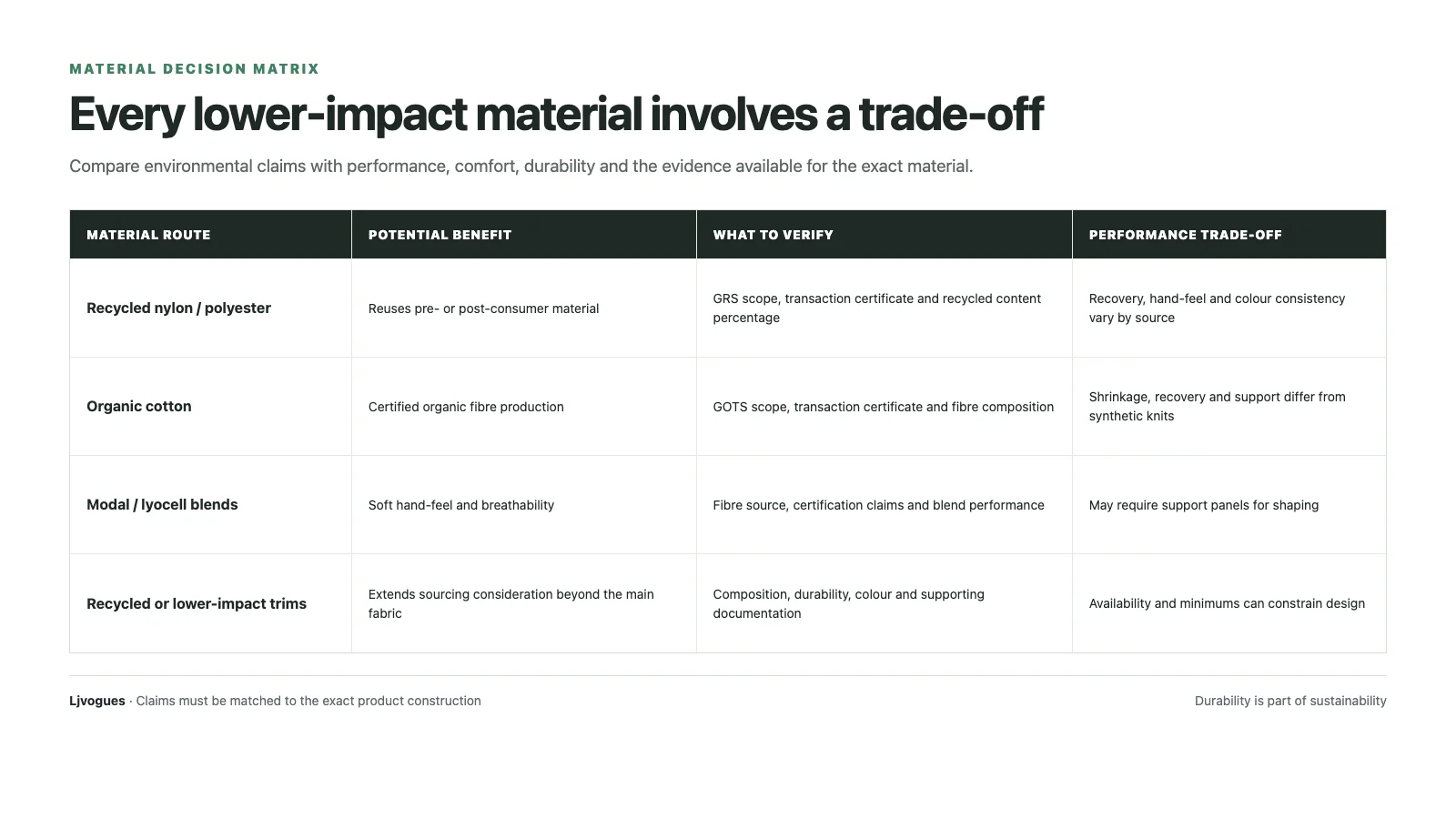
| Material route | Potential benefit | What to verify | Performance trade-off |
|---|---|---|---|
| Recycled nylon or polyester | Reuses pre- or post-consumer material | GRS scope, transaction certificate and recycled content percentage | Recovery, hand-feel and colour consistency vary by source |
| Organic cotton | Certified organic fibre production | GOTS scope, transaction certificate and fibre composition | Shrinkage, recovery and support differ from synthetic knits |
| Modal or lyocell blends | Soft hand-feel and breathability | Fibre source, certification claims and blend performance | May require support panels for shaping |
| Lower-impact trims | Extends sourcing decisions beyond the main fabric | Composition, durability, colour and supporting documentation | Availability and minimums can constrain design |
Recycled content and performance are separate questions. A recycled nylon may have excellent stretch recovery—or it may not. Always test the exact yarn, knit, dye and finishing route used for the product.
“Bamboo” is not automatically a fully sustainable solution. The fibre source, processing route, chemical recovery, certification and end-of-life should be reviewed before using a broad environmental claim.
3. Understand the certification chain
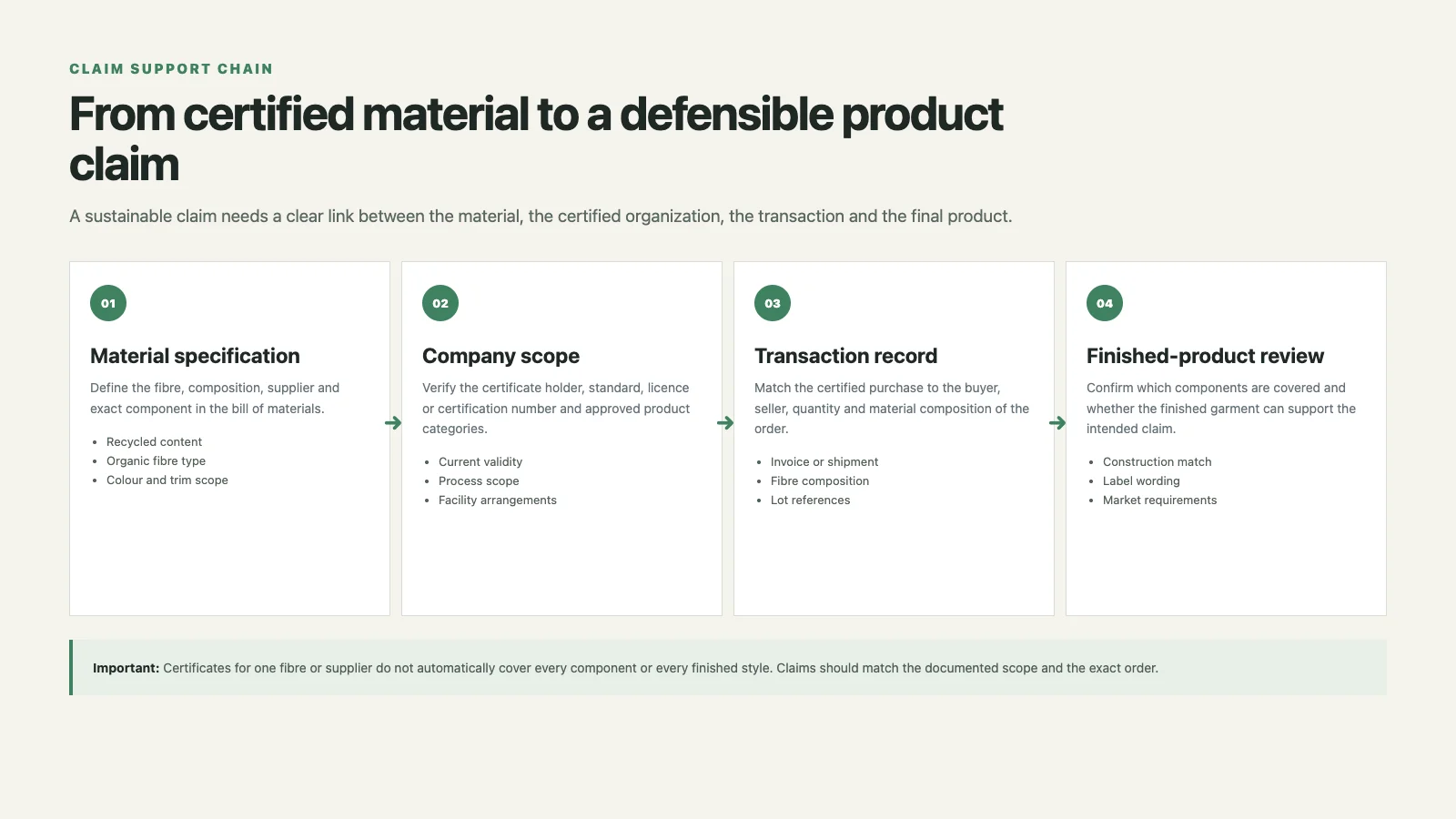
Material specificationFibre type, composition, supplier and exact component in the bill of materials.
Company scopeCertificate holder, standard, licence or certification number, product categories and validity.
Transaction recordBuyer, seller, quantity, composition, invoice or shipment reference and lot details.
Finished-product reviewWhich components are covered and whether the final garment can carry the intended claim.
For a deeper explanation of the difference between a scope certificate and a transaction certificate, read our GOTS certification update.
Ljvogues can provide OEKO-TEX certificate 26.HCN.12213 and GOTS licence GOTS-BVCN9928 for review where the material and order scope match. Buyers should request current documents and confirm the exact scope for the proposed product.
4. Sustainable materials create real manufacturing challenges
Elasticity and recovery
Recycled nylon and polyester still need the right elastane blend, knit structure and finishing to deliver support and recovery. A change in fibre source can alter hand-feel, shrinkage and how the fabric behaves after washing.
Dyeing and colour consistency
Recycled feedstocks can vary by lot. Lab dips, colour standards and production approvals become even more important when the buyer expects consistent colour across multiple fabric and trim suppliers.
Material availability and MOQ
Certified or lower-impact fabrics may have limited colours, widths or stock. A material that looks suitable in a swatch may require a higher minimum order or a longer lead time. Confirm availability before finalising the collection plan.
Blended constructions
Period panties, shapewear and bras often combine several materials. The sustainable claim may apply to one component while the barrier, absorbent core or elastic follows a different route. Define the claim by component rather than generalising across the whole garment.
5. Durability is part of sustainability
A product that loses recovery, shrinks, fades or delaminates quickly creates more waste and returns. Longevity should be tested alongside material certification.
- Stretch and recovery after the agreed wash routine
- Shrinkage and dimensional stability
- Colourfastness, staining and appearance retention
- Bonding and seam integrity
- Pilling, surface wear and hand-feel change
- Care-label instructions that match the tested routine
For period panties, durability also includes the functional layer and barrier. For shapewear, it includes compression recovery and edge stability. For everyday bras and panties, fit retention and elasticity are central.
Our quality control guide explains how to connect material inspection, inline checks and final AQL inspection.
6. Packaging and trims should be part of the sourcing brief
Packaging claims need the same care as fibre claims. “Biodegradable,” “compostable” and “recyclable” are not interchangeable, and local waste infrastructure affects how a material should be described.
When reviewing packaging, ask:
Material sourceRecycled paper, FSC-certified paper, recycled plastic or another documented route.
End-of-life claimRecyclable, compostable or biodegradable—verified for the exact material and market.
FunctionProtection from moisture, compression and contamination during export transit.
Printing and adhesivesInks, coatings and labels compatible with the intended recycling or disposal route.
Carton formatRetail, e-commerce or distributor packing requirements and barcode readability.
Local rulesDestination-market packaging and labelling requirements.
Trims matter too: recycled polyester thread, lower-impact elastics, paper hangtags, recycled hardware and plastic-free alternatives should be evaluated for availability, strength and colour consistency.
7. MOQ, sampling and production planning
| Route | Typical starting point | Buyer check |
|---|---|---|
| Ready-stock style | From 50 pcs | Available colours, sizes and material construction |
| Custom style | From 300 pcs per style and colour | Pattern, certification scope and branding |
| Custom fabric | Usually 500–1,000 pcs depending on the mill and colour | Certified material availability, dye lot and testing |
| Stock sample | Usually within 72 hours | Sample availability and freight |
| Custom sample | Usually 7–10 days after tech pack and fabric confirmation | Material approval and revision route |
| Bulk production | Typically 25–45 days after approval and deposit | Material lead time, capacity and inspection date |
Start with a material and certification review before committing to a full collection. A lower-impact fabric that cannot meet the required fit, colour or delivery date is not a practical sourcing solution.
8. Greenwashing checklist before publishing product claims
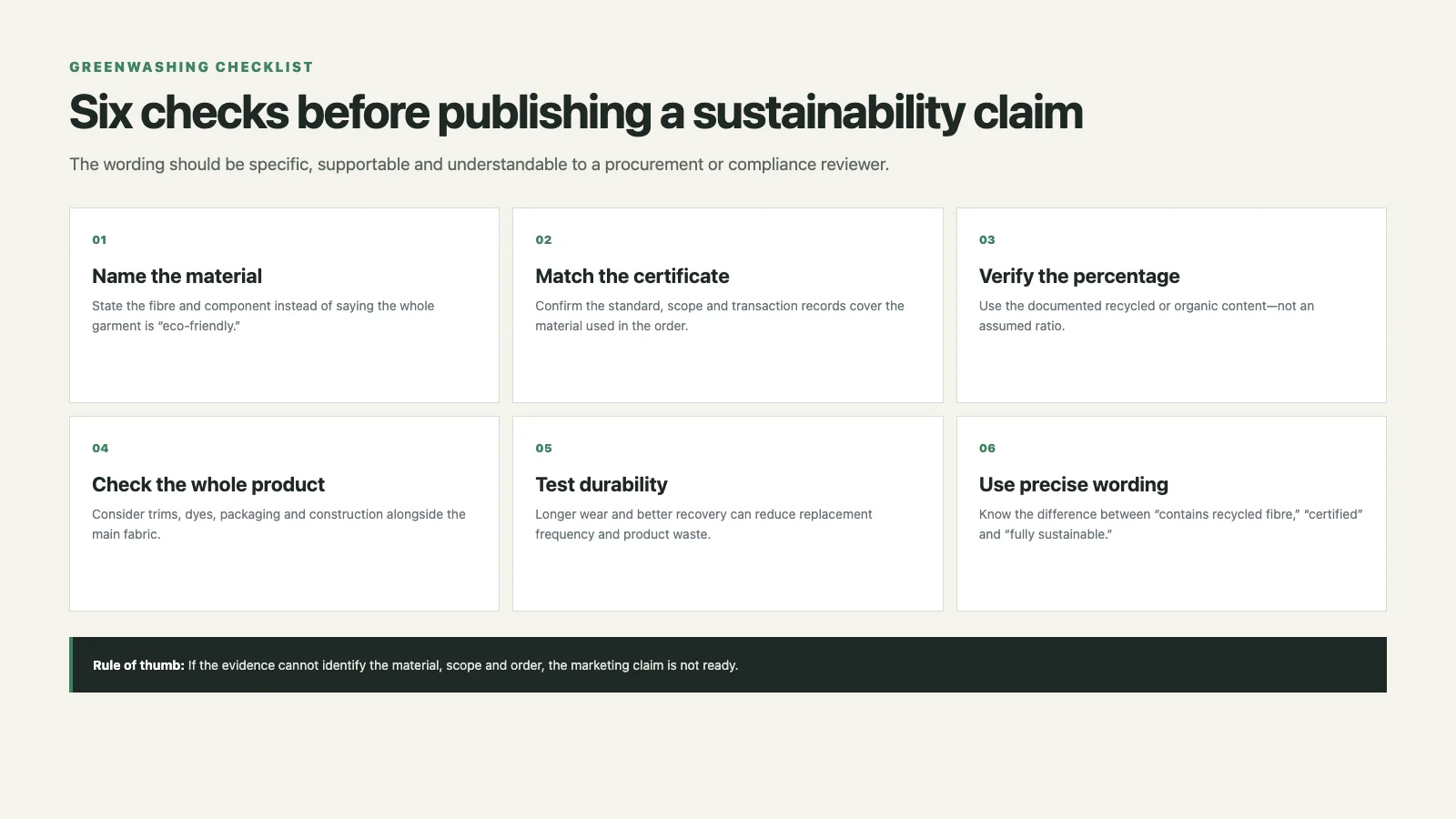
- Name the material and component. Avoid implying that the whole garment is certified when only one fibre is covered.
- Match the certificate. Confirm the standard, holder, scope and validity for the exact material.
- Verify the percentage. Use documented recycled or organic content—not an assumed ratio.
- Review the whole product. Include trims, dyes, packaging and construction.
- Test durability. Support longevity expectations with wash and recovery evidence.
- Use precise wording. Distinguish “contains recycled fibre,” “certified material” and “fully sustainable.”
Procurement rule
If the evidence cannot identify the material, certificate scope and order, the claim is not ready for a product page, hangtag or retail listing.
FAQ: sustainable lingerie sourcing
What does GRS-certified recycled nylon actually verify?
GRS covers recycled content, chain-of-custody and applicable environmental and social requirements within the certified scope. Buyers should verify the scope certificate and the transaction certificate for the exact material and purchase.
Does organic cotton make the whole garment sustainable?
No. Organic cotton concerns the fibre and its certified processing scope. The garment may also include elastane, absorbent layers, barrier materials, dyes, trims and packaging that require separate review.
How can buyers prevent greenwashing claims?
Name the material and component, verify the certificate scope and transaction records, confirm percentages, review the whole product and use wording that matches the evidence. Avoid broad claims such as “100% sustainable.”
Are biodegradable or compostable polybags always available?
Availability depends on the material, supplier and destination market. The terms “biodegradable,” “compostable” and “recyclable” should be verified for the exact packaging and supported by appropriate certification or test evidence.
Can Ljvogues develop an organic cotton or recycled fibre lingerie collection?
Yes, subject to material availability, certification scope and order quantity. We review the proposed construction, fibre composition and intended claim before confirming the sourcing and sampling route.
Planning a lower-impact lingerie collection?
Share your target product, fibre direction, certification claim, order quantity and destination market. Our team can review the material and documentation route before sampling.
Reviewed by Ocean Yang, Founder & CEO of Ljvogues. This guide reflects current OEM/ODM sourcing practice as of October 2026. Certification scope, recycled or organic content, performance claims, MOQ, testing and commercial terms must be confirmed for the exact material and order.

Ocean Yang
Founder & CEO | LjvoguesOcean Yang is the founder and CEO of Ljvogues. He writes about intimate apparel sourcing, material selection, fit development and factory quality control.
Read the full author profile →Related articles

Designing and Manufacturing Modern Shapewear: Balancing Comfort and Compression
Engineer shapewear and soft contour wear with balanced compression, fabric recovery, bonded edges, fit grading, sampling and OEM/ODM quality control.
By Ocean Yang - Read article →
Minimizing Defect Rates in Lingerie Mass Production: A Quality Control Guide
Reduce lingerie production defects with incoming material checks, inline QC, AQL 2.5 inspection, defect classification and corrective action.
By Ocean Yang - Read article →
From Concept to Bulk Production: A Complete Guide to Lingerie Tech Packs
Build a production-ready lingerie tech pack: technical flats, BOM, measurements, construction, color standards, sampling feedback and bulk handoff.
By Ocean Yang - Read article →