WhatsApp: +86 199 2880 2613

Lingerie Manufacturing Guides
From Concept to Bulk Production: A Complete Guide to Lingerie Tech Packs
Build a production-ready lingerie tech pack: technical flats, BOM, measurements, construction, color standards, sampling feedback and bulk handoff.
Quick answer for brand owners and buyers
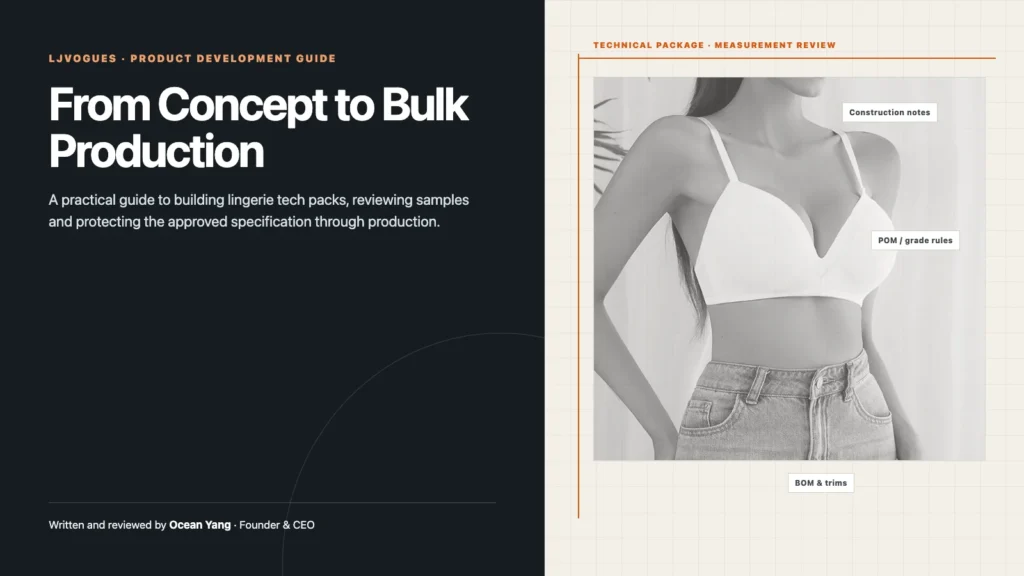
A lingerie tech pack is the controlled specification used by pattern makers, material buyers, sampling rooms and QC teams. It should define the design, measurements, construction, materials, colors, branding, packaging and acceptance requirements. The goal is not to create a longer document—it is to remove ambiguity before sampling and make the approved sample repeatable in bulk.
Most sampling delays do not begin in the sample room. They begin with a design brief that leaves key decisions open: which fabric, which edge finish, which measurements, which label, which color standard or which size grade.
A well-built tech pack reduces those gaps. It is not simply a PDF sent to a factory—it becomes the shared record that connects design intent, costing, pattern development, sample approval and bulk inspection.
1. What a lingerie tech pack is—and what it is not
A tech pack is a technical package that describes how a style should be built. For intimate apparel, it needs more precision than a fashion sketch because fit, stretch recovery, skin contact and small trim details all affect the final product.
- It is a production reference: the factory should be able to identify the style, materials, construction, measurements, branding and packing requirements without guessing.
- It is a communication record: questions, decisions and revisions should be documented so the buyer and factory are working from the same version.
- It is not a substitute for a sample: even a complete pack must be validated physically for fit, hand-feel and workmanship.
- It is not automatically a legal contract: commercial terms, IP ownership, payment, delivery and Incoterms belong in the quotation, purchase order and applicable agreement.
2. Eight sections every usable lingerie tech pack should include
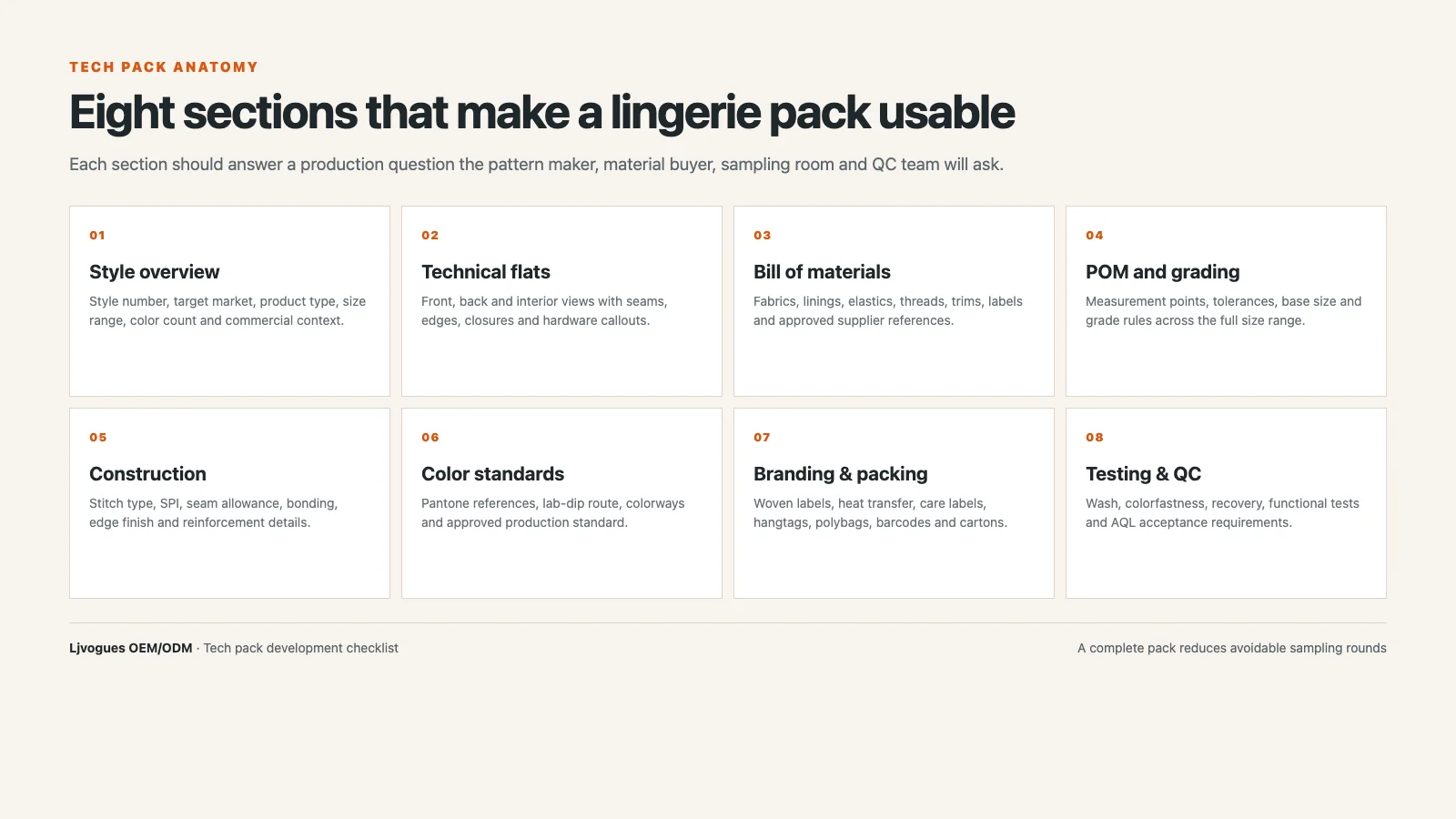
Style overview
Include the style number, product type, target market, intended size range, color count, target quantity, target FOB and launch window. Add the buyer’s technical contact and the current version date. This prevents an old document from being used for a new sample round.
Technical flats
Provide front, back and interior views. Mark seams, darts, cup edges, strap attachment, closures, lace placement, bonding zones and any topstitching. A fashion illustration can show the mood, but a technical flat should show how the garment is assembled.
Bill of materials
List every component used in one finished unit: main fabric, lining, gusset layers, elastic, thread, hardware, labels and packaging. Include composition, weight or thickness, width, color reference and approved supplier or quality level where known.
Points of measure and grading
Define the base size, measurement points, tolerances and grade rules for the full range. For bras, this may include underband, cup width, strap length and wire or support measurements. For panties, include waist, rise, leg opening and gusset dimensions. Avoid sending only one size chart without explaining how it grades.
Construction and stitching
Specify stitch type, stitches per inch, seam allowance, seam type, edge finish, bonding method, reinforcement and closure construction. For seamless products, identify adhesive or bonding zones and the required edge appearance. For lace or mesh, state how the trim is attached and finished.
Color standards
Use physical or approved textile color references rather than screen colors. Define how lab dips are submitted, how many colorways are required and who approves the final standard. Record whether color must match across the bra, panty, elastic and packaging.
Branding, labels and packaging
Show label placement, logo size, care and content wording, country-of-origin requirements, hangtags, size stickers, barcodes, polybags, gift boxes and master-carton marks. Include artwork files and confirm who supplies each component.
Testing and quality requirements
State the tests relevant to the style: wash, colorfastness, shrinkage, stretch recovery, pilling, bonding strength, absorbency or other functional performance. Agree the sampling plan, defect classification and AQL acceptance criteria before bulk production.
3. What changes for bras, panties, shapewear and period panties
Bras
Bras require a stronger focus on cup construction, underband tension, strap placement, wire or wireless support and grade rules across cup sizes. A single fit sample is not enough to prove the size range. Include construction details for foam, moulded cups, cut-and-sewn cups, lining and hardware.
Panties
For panties, define rise, front and back coverage, leg-opening stretch, gusset dimensions and waistband recovery. Small changes in elastic tension or pattern shape can change comfort and return rates. Include seam and gusset construction clearly.
Shapewear
Shapewear packs should specify compression zones, fabric and panel direction, seam placement, edge pressure, closures and recovery expectations. Include target compression and comfort requirements in a measurable way if these will be used in product claims.
Period panties
Add a functional zone map, layer order, absorbent core, barrier material, gusset coverage, wash protocol and performance testing. The exact layer count should be tied to the tested construction—not copied from a generic four-layer template. For a deeper technical review, read our period panty manufacturing guide.
4. Turn sample comments into a controlled revision record
The first prototype should be reviewed against the tech pack, not only against personal preference. Fit models, measurements, materials, construction and branding should be checked separately so comments are not mixed into one general instruction.
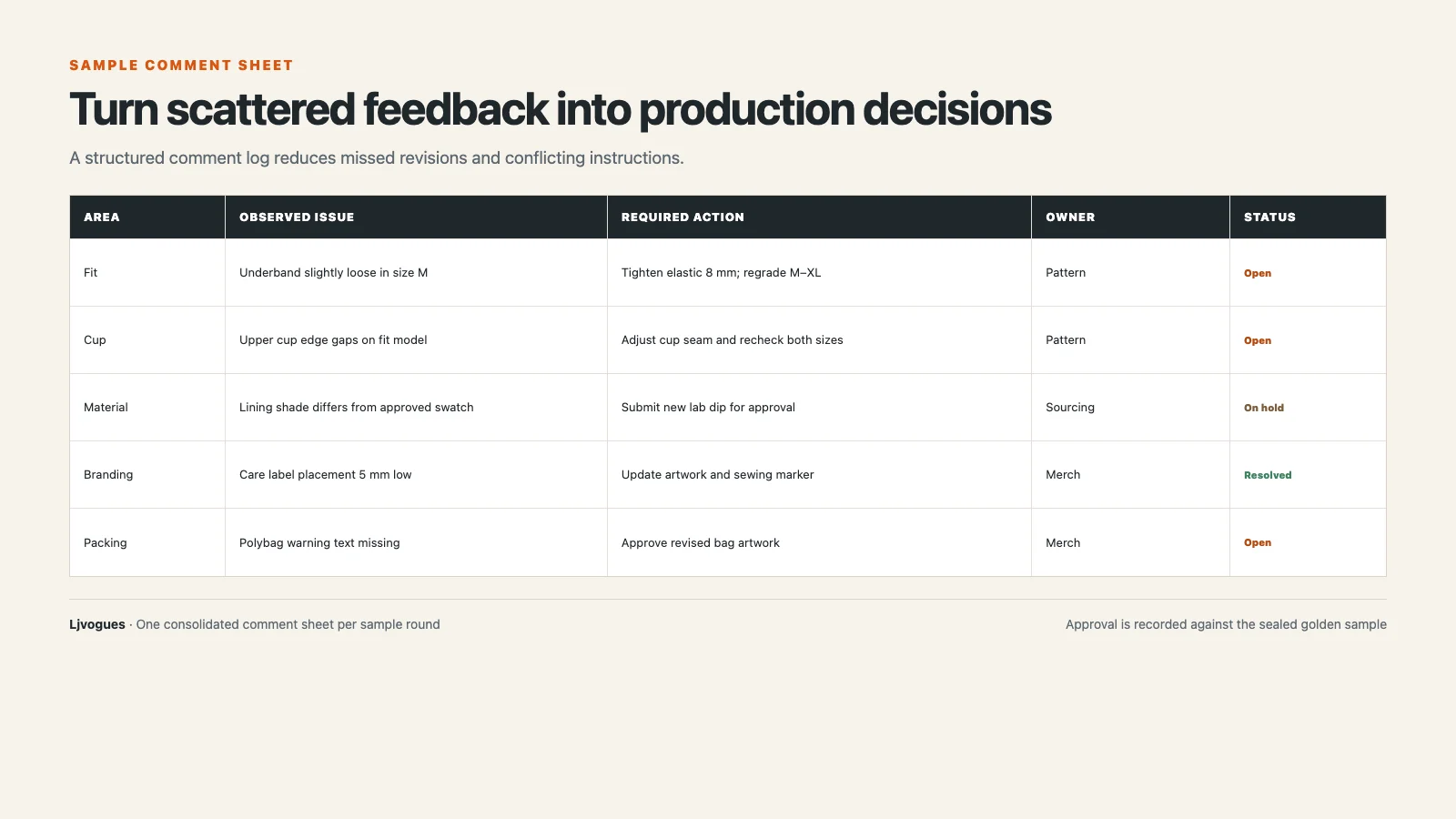
A useful comment sheet records:
AreaFit, cup, measurement, fabric, elastic, construction, color, label or packing.
Observed issueDescribe what is wrong in objective terms and include photos or measurements where possible.
Required actionState the intended correction rather than only saying “adjust” or “improve.”
OwnerAssign the pattern maker, material supplier, merchandiser or factory technician responsible.
StatusOpen, on hold, resolved or approved—so nothing is lost between rounds.
VersionRecord the sample round and date so later decisions do not overwrite approved work.
Once the buyer approves the revised sample, seal a golden sample. It becomes the benchmark for measurements, materials, color, construction and packaging. The approved tech pack, comment sheet and golden sample should all point to the same version.
5. From concept to bulk production
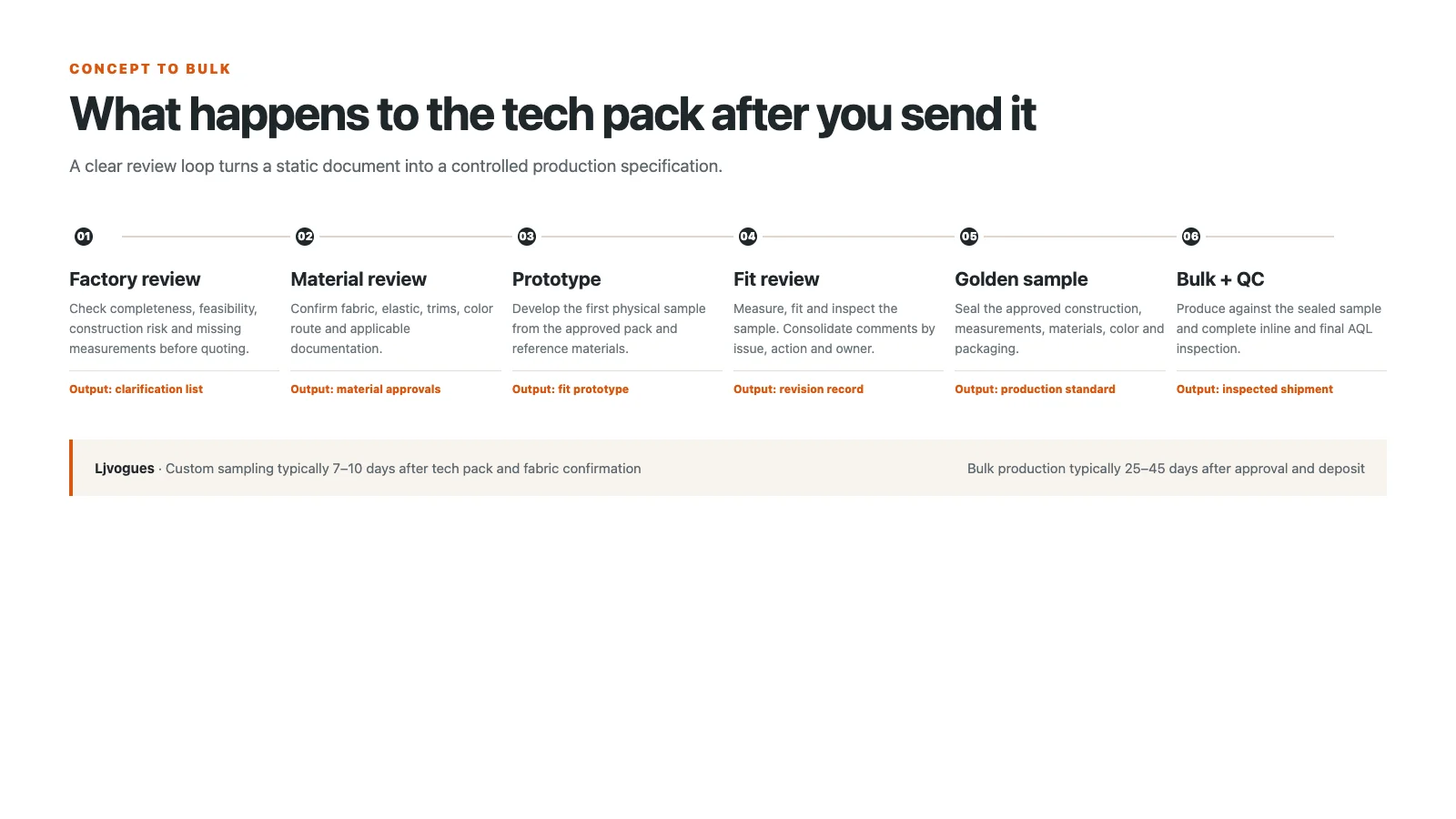
- Factory technical review: the factory checks completeness, construction feasibility and measurement gaps before quoting.
- Material confirmation: fabrics, elastics, trims, colors and applicable documentation are approved for sampling.
- Prototype development: the sample room builds the first physical version from the approved pack.
- Fit and workmanship review: the buyer measures, fits and inspects the sample, then returns consolidated comments.
- Golden-sample approval: the approved sample is sealed as the production benchmark.
- Bulk production and inspection: production follows the sealed standard, with inline checks and final AQL inspection.

6. MOQ, sampling and bulk lead times
Your tech pack should include the commercial context because the factory needs to recommend the right route, not only the right construction.
| Commercial point | Typical starting point | What the buyer should confirm |
|---|---|---|
| Ready-stock MOQ | From 50 pcs | Available colors, sizes and stock construction |
| Custom style MOQ | From 300 pcs per style and color | Material route, color count, branding and packaging |
| Custom fabric MOQ | Usually 500–1,000 pcs depending on the mill and color | Dye lot, minimum quantity, testing and lead time |
| Stock sample | Usually within 72 hours | Availability and freight |
| Custom sample | Usually 7–10 days after tech pack and fabric confirmation | Revision rounds, sample fee and approval route |
| Bulk production | Typically 25–45 days after approval and deposit | Material, capacity, inspection and shipping dates |
These are starting benchmarks, not universal commitments. Complex construction, custom fabric or a peak-season booking can change the timeline. The quotation and proforma invoice should state the exact terms for the order.
7. Common tech pack mistakes that delay sampling
- Sending a mood board without technical flats or construction callouts
- Listing a fabric name without composition, weight, stretch or color standard
- Providing one measurement chart without grade rules or tolerances
- Using a digital screen color as the only color reference
- Leaving label, packaging and barcode requirements until after the sample is approved
- Combining fit, construction and material comments into vague instructions such as “make tighter” or “improve quality”
- Approving a style without recording the final sample version
Version control matters
Name files consistently—style number, document type, version and date. When a measurement, fabric or construction changes, update the tech pack and note what changed. The factory should not be expected to reconcile several conflicting PDFs.
8. Production handoff checklist
Before bulk production is released, confirm that the following documents and approvals match:
- Final tech pack with a clear version date
- Approved bill of materials and supplier references
- Approved color standards and lab dips
- Final graded measurement chart with tolerances
- Signed sample comments and revision record
- Sealed golden sample with photos
- Approved branding, care-label and packaging artwork
- Testing requirements and AQL inspection criteria
- Confirmed MOQ, price, delivery, payment and Incoterm
For more detail on choosing a production route, see our B2B lingerie and shapewear sourcing guide and our OEM/ODM services.
FAQ: lingerie tech packs and sampling
Do I need a tech pack to request a lingerie quotation?
A complete tech pack produces a more accurate quotation and reduces back-and-forth. If you only have a sketch or reference sample, the factory can help identify missing information and develop a working pack before sampling.
Can a factory create a tech pack from a reference sample?
Yes. A technical team can reverse-engineer the construction, measurements, materials and trims from a physical reference. The buyer should still approve the written specification, material substitutions and measurements before the sample is sealed.
How long does custom lingerie sampling take?
At Ljvogues, custom sampling usually takes 7–10 days after the tech pack and fabric are confirmed. The timeline can change if a new fabric, mould, print or complex trim needs to be developed.
What is a golden sample?
A golden sample is the approved physical sample used as the production benchmark. It records fit, measurements, materials, color, construction, labels and packing expectations so bulk production can be checked against the same standard.
How does the tech pack support quality control?
The tech pack defines the measurement points, tolerances, construction and material requirements used during inline and final inspection. Ljvogues uses AQL 2.5 for major defects and AQL 1.0 for critical defects, with inspection records available for review.
Have a concept, sketch or tech pack ready for review?
Send your style references, target quantity, size range, material direction and intended market. Our team will review the specification and recommend the practical next step for sampling and quotation.
Reviewed by Ocean Yang, Founder & CEO of Ljvogues. This guide reflects current OEM/ODM development and sampling practice as of October 2026. MOQ, lead times, testing and commercial terms are confirmed for each specific product and order.

Ocean Yang
Founder & CEO | LjvoguesOcean Yang is the founder and CEO of Ljvogues. He writes about intimate apparel sourcing, material selection, fit development and factory quality control.
Read the full author profile →Related articles
Eco-Friendly Lingerie Manufacturing: Sustainable Materials & OEM/ODM Best Practices
Sustainable lingerie manufacturing guide: compare recycled nylon, organic cotton, OEKO-TEX, GRS/GOTS documentation, durability and OEM/ODM production.
By Ocean Yang - Read article →
Designing and Manufacturing Modern Shapewear: Balancing Comfort and Compression
Engineer shapewear and soft contour wear with balanced compression, fabric recovery, bonded edges, fit grading, sampling and OEM/ODM quality control.
By Ocean Yang - Read article →
Minimizing Defect Rates in Lingerie Mass Production: A Quality Control Guide
Reduce lingerie production defects with incoming material checks, inline QC, AQL 2.5 inspection, defect classification and corrective action.
By Ocean Yang - Read article →