WhatsApp: +86 199 2880 2613
Lingerie Manufacturing Guides
Manufacturing Period Panties: A Technical OEM/ODM Guide for Intimate Apparel Brands
Technical period panty manufacturing guide: functional layers, leak protection, bonding, wash testing, OEM/ODM MOQ and AQL 2.5 quality control.
Quick answer for period panty buyers
Treat the period panty as a complete functional system: body-facing fabric, absorbent core, liquid barrier, outer shell, gusset coverage and sealed construction all affect performance. Approve a physical sample after fit, wash and performance testing, then use the sealed sample and agreed AQL standard for bulk production. At Ljvogues, ready-stock styles can start from 50 pcs, custom styles from 300 pcs per style and color, and custom sampling usually takes 7–10 days.
Period panties look similar to ordinary underwear from the outside, but the manufacturing requirements are different. The gusset is a layered functional system, the barrier has to survive real wear and washing, and leak protection depends on coverage and construction as much as on the materials themselves.
For brand owners and procurement teams, the practical question is not simply “How many layers does the factory use?” It is whether the factory can define the use case, build a repeatable construction, test the finished garment and control the same specification in bulk.
1. Define the performance brief before selecting materials
A period panty program should start with a written performance brief. Without it, sampling becomes a series of subjective opinions rather than a controlled engineering review.
Use caseEveryday backup, light flow, moderate flow, heavier flow or overnight use—state the intended position clearly.
Garment silhouetteBikini, brief, high-waist, boyshort or thong; confirm rise, coverage, leg opening and gusset placement.
Target marketRecord relevant sizing, care expectations, labeling rules and any product-claim requirements for the destination.
Performance targetDefine absorbency, leak protection, wash durability and comfort requirements through an agreed test protocol.
Commercial targetSet target quantity, color count, packaging, target FOB and launch date before material sourcing begins.
Claims to supportList every intended marketing claim, including leakproof, antibacterial, reusable or recycled content, so testing can be planned.
This brief prevents a common sourcing problem: the factory samples one interpretation of “high absorbency,” the buyer evaluates another, and neither side has a written standard to resolve the difference.
2. Understand the functional gusset as a system
A period panty gusset is often described as a four-layer structure. That can be a useful starting point, but it should not be treated as a universal standard. Different designs may use more or fewer layers, different fibre blends, a film or coating, or a different order of materials.
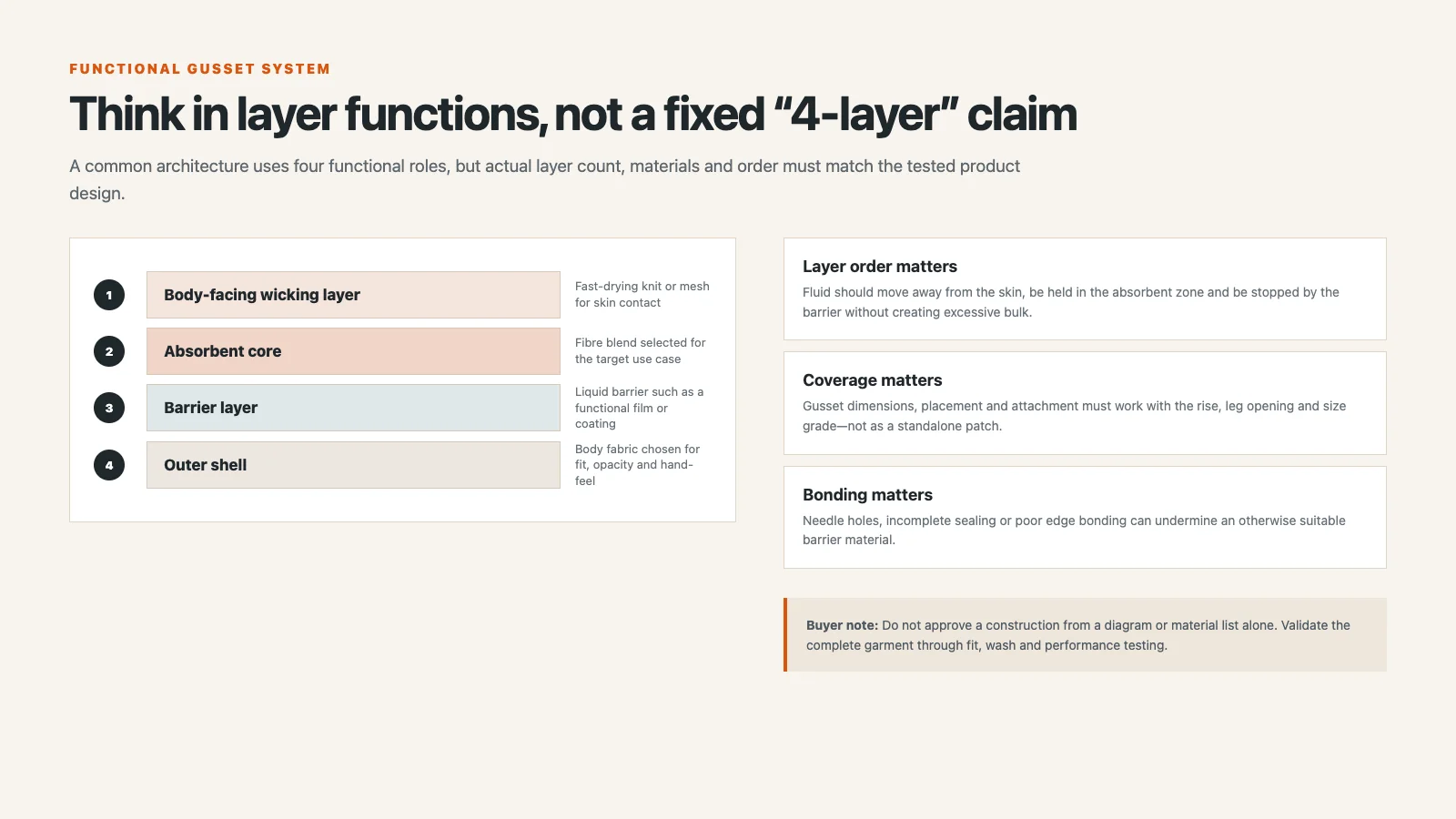
Body-facing wicking layer
This layer touches the skin. It should move moisture away from the body, dry reasonably quickly and feel comfortable during wear. Knit structure, fibre type and finishing all matter—not just a generic description such as “modal” or “mesh.”
Absorbent core
The core holds fluid and should control rewet under pressure. Fibre blend, density, thickness and the size of the functional area all affect capacity and how the garment feels when worn. A heavier core is not automatically better if it creates bulk, slows drying or changes the fit.
Barrier layer
The barrier prevents liquid from reaching the outer garment. A functional film or coating may be used, but its position and bonding method must be compatible with the surrounding materials. The barrier also has to remain intact after folding, washing and movement.
Outer shell and gusset attachment
The outer shell provides structure, opacity and fit. The gusset must be attached securely at the front and back, with enough coverage for the intended use case. A technically strong material stack can still fail if the gusset is too narrow, poorly positioned or attached with an unstable seam.
3. The manufacturing risks buyers should inspect
Bulk versus protection
Adding absorbency can make the gusset thicker, stiffer or more visible under clothing. The sample review should balance capacity, comfort, drying time and appearance rather than judging absorbency in isolation.
Seam leakage and bonding integrity
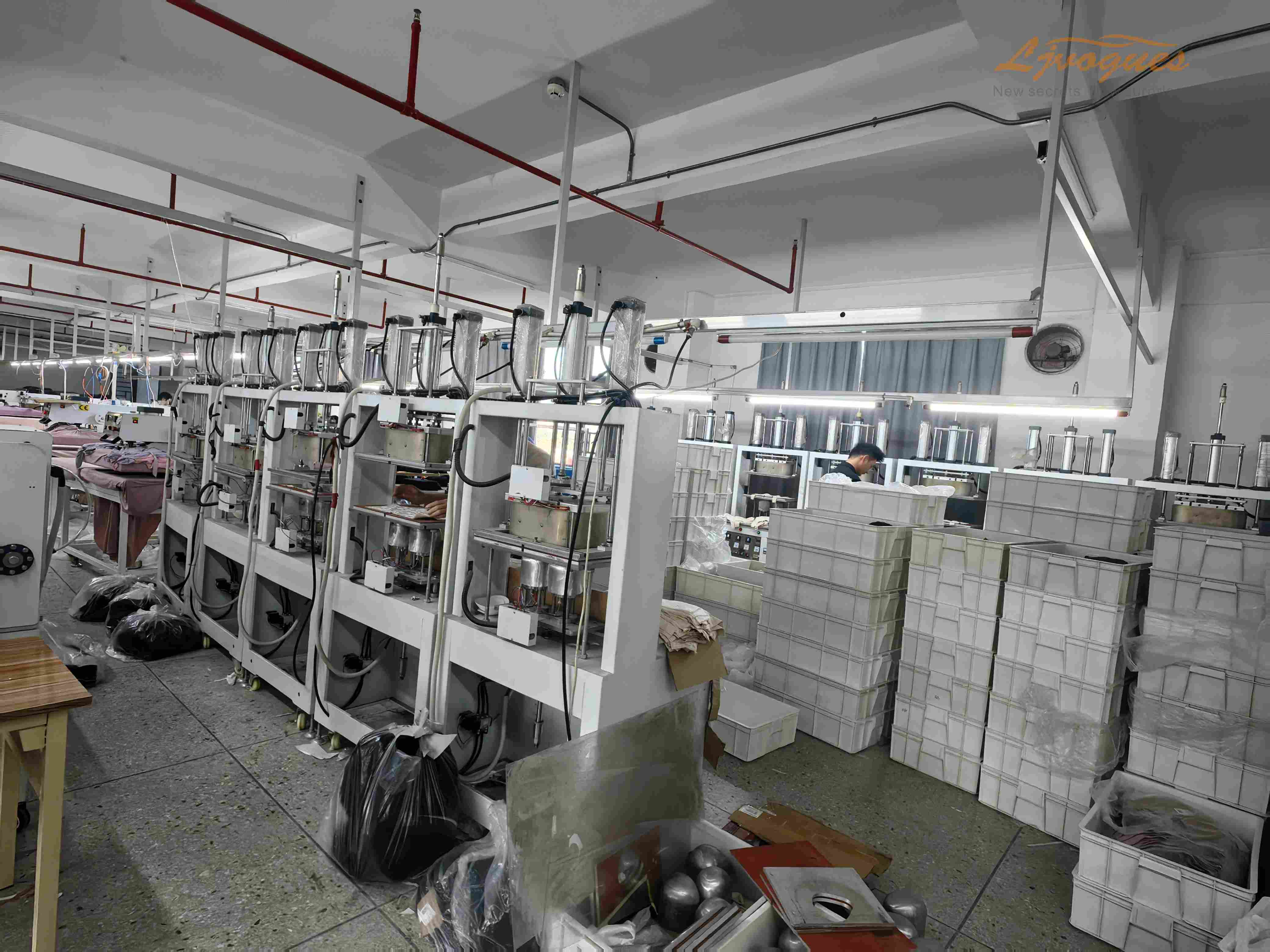
Needle stitching creates holes. In some constructions, those holes need to be sealed, covered or moved away from the barrier zone. Thermal bonding, adhesive lamination or ultrasonic welding can reduce needle penetration, but the bonded edge still needs to be strong enough for wear and washing.
Wash durability
Check whether the construction remains stable after the agreed number of wash cycles. Look for delamination, bubbling, shrinkage, edge lifting, colour change and loss of fit. A generic “machine washable” statement is not a substitute for a defined care routine and wash test.
Fit and size grading
Period panties need to stay close to the body without cutting in. Review the full size range, especially the rise, leg opening, gusset length and waistband recovery. A one-size fit sample does not prove that the grade will work for the target market.
Opacity and colour
Light-coloured outer fabrics can become visually compromised when layers shift or when the garment is stretched. Check opacity under tension, colourfastness and staining after the care routine.
4. Tech pack requirements specific to period panties
A standard underwear tech pack is not enough. The period panty pack should define the functional zone and the validation method alongside the garment measurements.
| Tech pack section | What to specify |
|---|---|
| Functional zone map | Front and back gusset coverage, layer order, attachment method and relationship to the rise. |
| Material stack | Fabric name, composition, weight, thickness, barrier type and approved supplier reference for each layer. |
| Absorbency target | The intended use case plus the internal test method and acceptance criteria. |
| Barrier and sealing | Film or coating specification, seam treatment, bonding method and edge-finishing requirements. |
| Wash protocol | Wash temperature, detergent, drying method, number of cycles and failure criteria. |
| Fit and grading | Points of measure, gusset dimensions, grade rules and fit-model feedback for the full size range. |
| Branding and care | Label placement, care wording, packaging, barcode and any claim-support language. |
If you are starting from a reference sample, ask the factory to build a written construction and measurement record before quotation. For the broader OEM/ODM process, see our custom lingerie and shapewear sourcing guide.
5. Test the complete product, not just the fabric
Material certificates are necessary but not sufficient. A fabric can be skin-safe and still perform poorly when combined with an absorbent core, barrier and bonded edge. The finished construction should be reviewed against the claims and market requirements you intend to use.
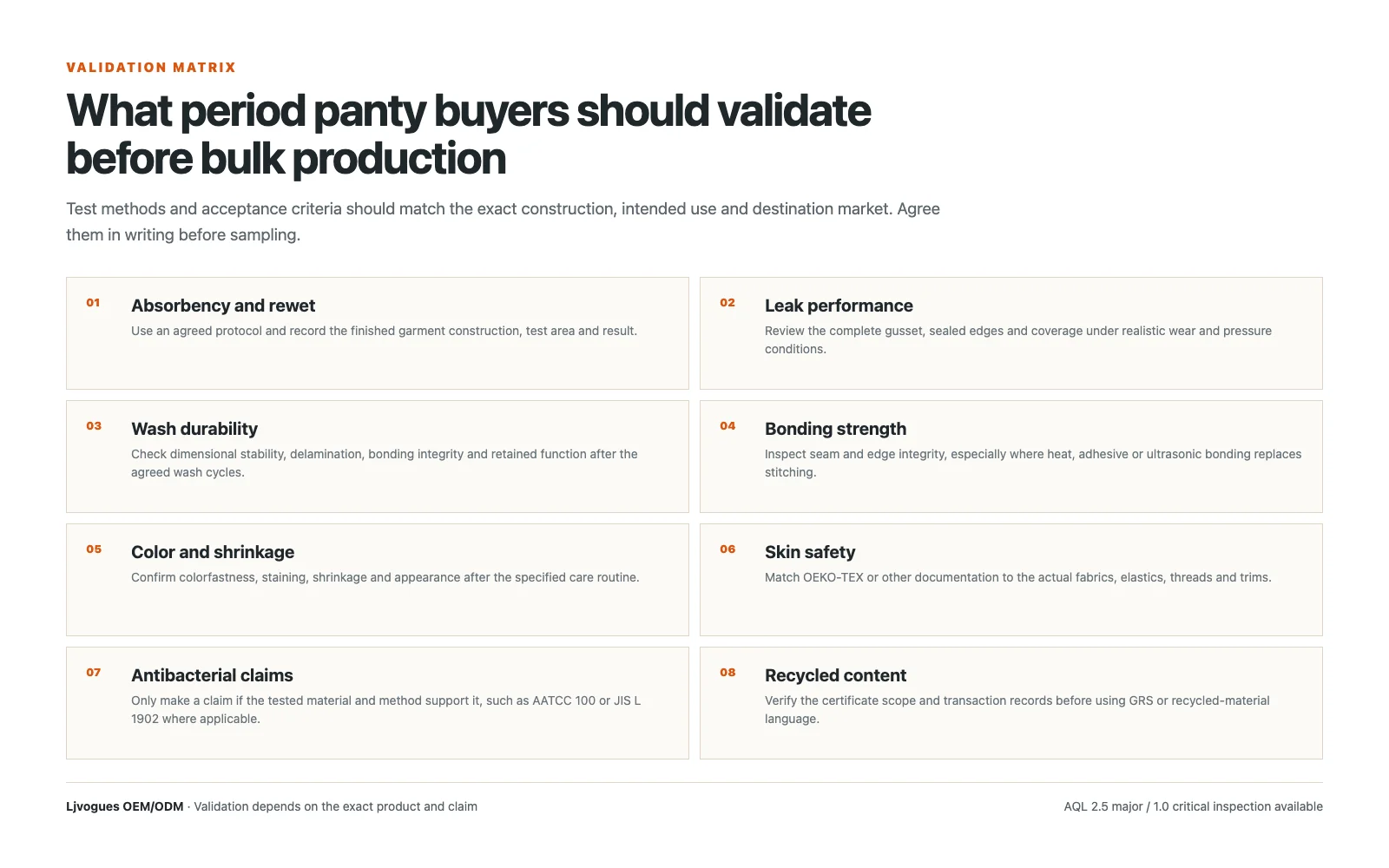
Common validation areas include:
- Absorbency and rewet: use a documented method and record the result for the finished functional zone.
- Leak performance: inspect the complete gusset, sealed edges and coverage under realistic wear and pressure conditions.
- Wash durability: check delamination, shrinkage, bonding failure, colourfastness and retained function after the agreed care routine.
- Skin-safety documentation: match OEKO-TEX Standard 100 or other applicable reports to the actual fabrics, elastics, threads and trims.
- Antibacterial claims: only make a claim where the tested material and method support it, using an applicable standard such as AATCC 100 or JIS L 1902 where relevant.
- Recycled or organic content: verify certificate scope and transaction records before using GRS, GOTS or recycled-material language.
Ljvogues can provide OEKO-TEX certificate 26.HCN.12213 and GOTS license GOTS-BVCN9928 for review where the material and order scope match. BSCI audit documentation is available for buyer review. Product-specific performance testing should be agreed for the exact construction.
Claims caution
Do not publish “leakproof,” “antibacterial,” “reusable for X washes” or “certified recycled” claims until the finished product and supporting documents match the wording. The exact fabric, construction and destination market matter.
6. MOQ, sampling and production planning
Period panty MOQ depends on whether you choose a ready-stock style, a custom development or a custom fabric. Specialized functional materials can create higher minimums than a standard panty program.
| Route | Typical starting point | Buyer check |
|---|---|---|
| Ready-stock style | From 50 pcs | Confirm available colours, sizes and current functional construction. |
| Custom style | From 300 pcs per style and colour | Confirm gusset construction, size curve, branding and packaging. |
| Custom fabric | Usually 500–1,000 pcs depending on the mill and colour | Confirm dye lot, lead time, testing and minimum order. |
| Stock sample | Usually within 72 hours | Confirm sample availability and freight. |
| Custom sample | Usually 7–10 days after tech pack and fabric confirmation | Confirm revision rounds and sample-fee treatment. |
| Bulk production | Typically 25–45 days after golden-sample approval and deposit | Confirm material, capacity and inspection dates in the PI. |
For a first collection, start with the smallest commercial route that still gives you a representative functional construction. A cheap sample made from unavailable materials does not prove that the bulk order can be produced consistently.
7. Quality control for period panty production
Quality control should cover both the garment and the functional zone. A normal visual inspection of a panty is not enough if the gusset placement, bonding or layer alignment changes during production.
- Inspect incoming functional materials for shade, weight, width and visible defects.
- Check cut-piece alignment and gusset placement against the approved pattern.
- Monitor bonding temperature, pressure, dwell time and edge integrity where thermal processes are used.
- Verify measurements and stretch recovery against the sealed golden sample.
- Check layer alignment, delamination risk and appearance after the agreed wash routine.
- Confirm label placement, packing count, barcode and carton marks before shipment.
Ljvogues uses AQL 2.5 for major defects and AQL 1.0 for critical defects, with material inspection, inline checks and final random inspection. Buyers should agree defect definitions and measurement tolerances before production starts.
You can review our factory and quality-control process, browse period panty reference styles or download relevant certificates and catalogues.
8. Questions to ask a period panty manufacturer
Can you show the layer map?Ask for a drawing or specification showing each functional role, material and attachment method.
How do you test leakage?The answer should reference a defined finished-garment method, sample preparation and pass/fail criteria.
How is the barrier sealed?Confirm whether stitching, bonding, lamination or a combination is used and how the edge is protected.
What happens after washing?Ask for wash-cycle evidence on the exact construction, including delamination and dimensional stability.
Can you support our claims?The factory should explain which tests and documents are relevant to each intended marketing claim.
How will bulk stay consistent?Ask about golden samples, material lot control, inline checks and final AQL inspection.
FAQ: period panty manufacturing and sourcing
What is the MOQ for custom period panties?
At Ljvogues, ready-stock styles can start from 50 pcs and custom styles typically start at 300 pcs per style and colour. Custom fabric development usually starts at 500–1,000 pcs depending on the mill and colour. The final MOQ depends on the construction and material route.
Can you manufacture a four-layer period panty?
We can review four functional roles—body-facing wicking, absorbent core, barrier and outer shell—but the final layer count and material order must be matched to the intended use case and tested construction. We do not recommend approving a period panty from a layer count alone.
How do you reduce leakage at the seams and edges?
We review gusset coverage, pattern alignment, barrier placement and the attachment method. Depending on the design, thermal bonding, adhesive lamination or protected stitching may be appropriate. The finished garment should then be tested for leak performance and wash durability.
Which tests should a period panty buyer request?
The test plan should match the intended claims. Typical areas include absorbency and rewet, leak performance, wash durability, delamination, colourfastness, shrinkage, skin-safety documentation and any antibacterial or recycled-content claim. Test methods and acceptance criteria should be agreed in writing.
Can you use organic cotton or recycled materials?
Yes, subject to material availability, the required certification scope and the order quantity. We verify GOTS or recycled-content documentation against the actual materials before agreeing to product claims. Certification for one component does not automatically cover the finished garment.
Developing a period panty collection?
Share your intended use case, reference style, target quantity, size range and claims. Our team will review the functional construction, sampling route and testing plan before quotation.
Reviewed by Ocean Yang, Founder & CEO of Ljvogues. This guide reflects current OEM/ODM development and inspection practice as of October 2026. Performance claims, MOQ, testing and commercial terms must be confirmed for the exact fabric, construction and order.

Ocean Yang
Founder & CEO | LjvoguesOcean Yang is the founder and CEO of Ljvogues. He writes about intimate apparel sourcing, material selection, fit development and factory quality control.
Read the full author profile →Related articles
Eco-Friendly Lingerie Manufacturing: Sustainable Materials & OEM/ODM Best Practices
Sustainable lingerie manufacturing guide: compare recycled nylon, organic cotton, OEKO-TEX, GRS/GOTS documentation, durability and OEM/ODM production.
By Ocean Yang - Read article →
Designing and Manufacturing Modern Shapewear: Balancing Comfort and Compression
Engineer shapewear and soft contour wear with balanced compression, fabric recovery, bonded edges, fit grading, sampling and OEM/ODM quality control.
By Ocean Yang - Read article →
Minimizing Defect Rates in Lingerie Mass Production: A Quality Control Guide
Reduce lingerie production defects with incoming material checks, inline QC, AQL 2.5 inspection, defect classification and corrective action.
By Ocean Yang - Read article →