WhatsApp: +86 199 2880 2613

Lingerie Manufacturing Guides
Designing and Manufacturing Modern Shapewear: Balancing Comfort and Compression
Engineer shapewear and soft contour wear with balanced compression, fabric recovery, bonded edges, fit grading, sampling and OEM/ODM quality control.
Quick answer for product teams
Modern shapewear is engineered around the balance between compression and comfort. The result depends on fabric modulus and recovery, panel geometry, seam placement, size grading and edge finishing—not simply a higher spandex percentage. Approve every style on fit models across the full size range, verify recovery after washing and seal a golden sample before bulk production.
The shapewear category has moved beyond extreme waist cinching. Consumers now expect smoothing, support and a clean silhouette under clothing without the garment rolling, digging, overheating or feeling difficult to put on.
For brands, that means the product brief should define where control is needed, how much movement the wearer needs and what the garment should look like under different clothing. “Firm compression” without a measurable fit target is not enough.
1. From rigid corsetry to engineered comfort
Modern shapewear uses textile engineering rather than heavy boning and rigid structure in most everyday products. The aim is controlled stretch, targeted support and a smooth transition between zones.
This creates design questions that need to be answered during pattern development:
- Which areas need firm smoothing, moderate support or softer stretch?
- Should the control come from the knit, an internal panel, seam geometry or a combination?
- How will the wearer sit, bend, walk and use the bathroom?
- What rise, leg opening and edge finish will stay comfortable for the intended wear time?
- Will the construction remain invisible under fitted clothing and retain its shape after washing?
2. Design zonal compression, not uniform tightness
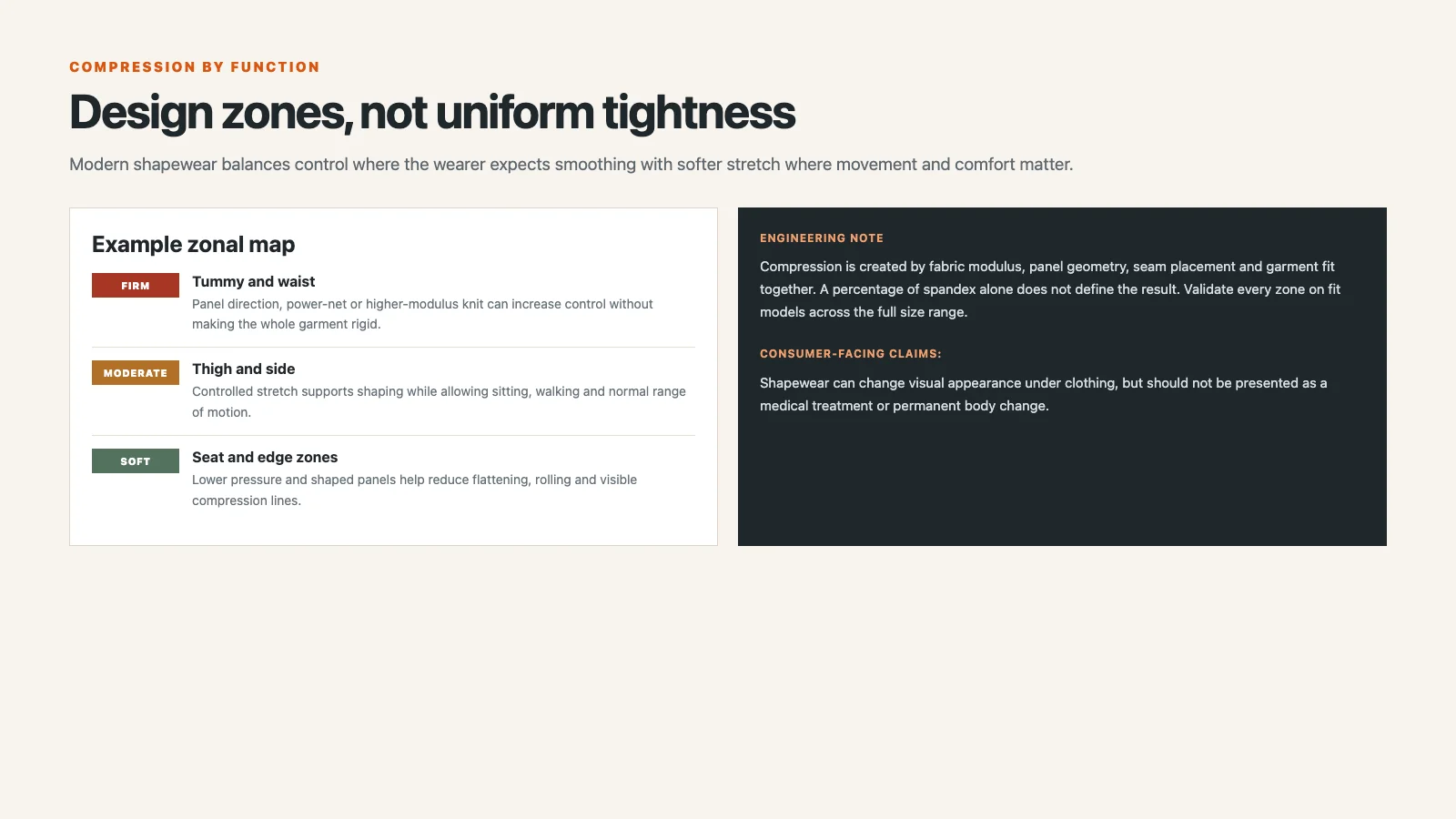
Zonal construction can use different knit structures, panel direction, power-net reinforcement or seam placement. The same outer fabric can behave differently when the panel orientation or lining changes.
When reviewing a sample, do not rely only on how tight the garment feels on a table. Wear it on representative fit models and check:
Tummy and waistExpected smoothing without excessive pressure, rolling or restricted breathing.
Hip and thighSupport through movement without cutting, twisting or riding up.
SeatShape and lift without flattening or creating a visible compression line.
EdgesFlat, stable and comfortable against the skin under fitted clothing.
ClosuresSecure and easy to use without pressure points or hardware visibility.
Wear timeComfort, heat and movement after extended wear—not just a short fitting.
3. Choose fabrics by function, not spandex percentage alone
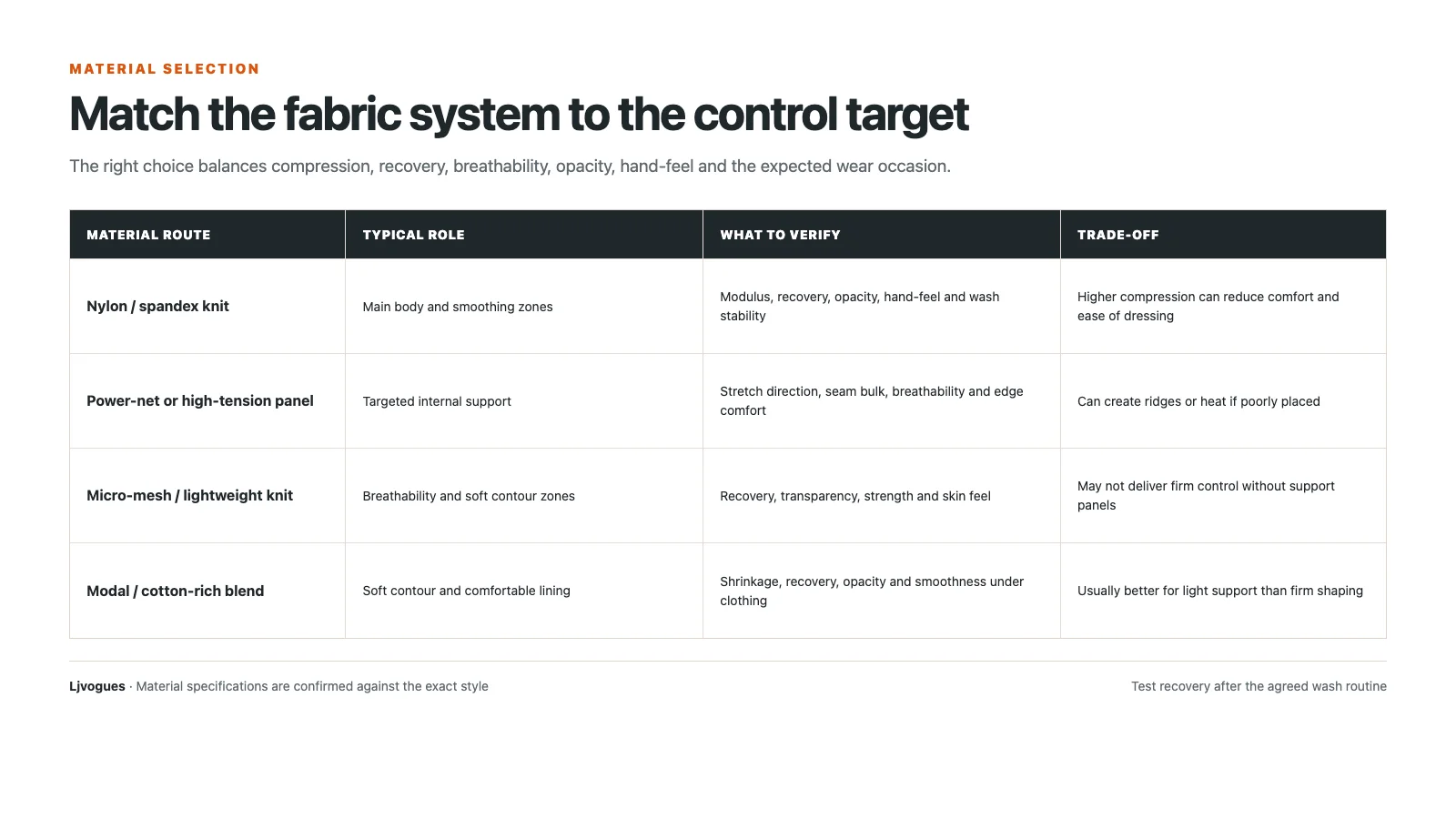
| Material route | Typical role | What the buyer should verify |
|---|---|---|
| Nylon / spandex knit | Main body and smoothing zones | Modulus, stretch recovery, opacity, hand-feel and wash stability |
| Power-net or high-tension panel | Targeted internal support | Stretch direction, seam bulk, breathability and edge comfort |
| Micro-mesh or lightweight knit | Breathability and soft contour zones | Recovery, transparency, strength and skin feel |
| Modal or cotton-rich blend | Soft contour and comfortable lining | Shrinkage, recovery, opacity and smoothness under clothing |
High spandex content can improve stretch, but it does not automatically create comfortable shaping. Fabric weight, knit structure, modulus, recovery and panel direction all affect how the garment holds the body.
Ask for fabric performance data rather than relying on a generic description such as “high-compression fabric.” Test the exact fabric and construction after the agreed wash routine.
4. Fit and grading determine whether compression works across sizes
Compression garments are especially sensitive to grading. A change in body circumference, rise or leg opening can change how the same fabric behaves on a larger size.
- Develop the base pattern around the intended support zones, not only the size chart.
- Fit each critical size on representative models—not only the base size.
- Check whether larger sizes become too restrictive or smaller sizes lose control.
- Review length, rise, crotch and leg-opening dimensions after the garment is stretched.
- Confirm that closures, seams and edges stay comfortable through movement.
If the size grade only changes flat measurements without considering stretch and panel geometry, the garment may fit correctly on a table and still fail on the body.
5. Manufacturing risks that require factory control
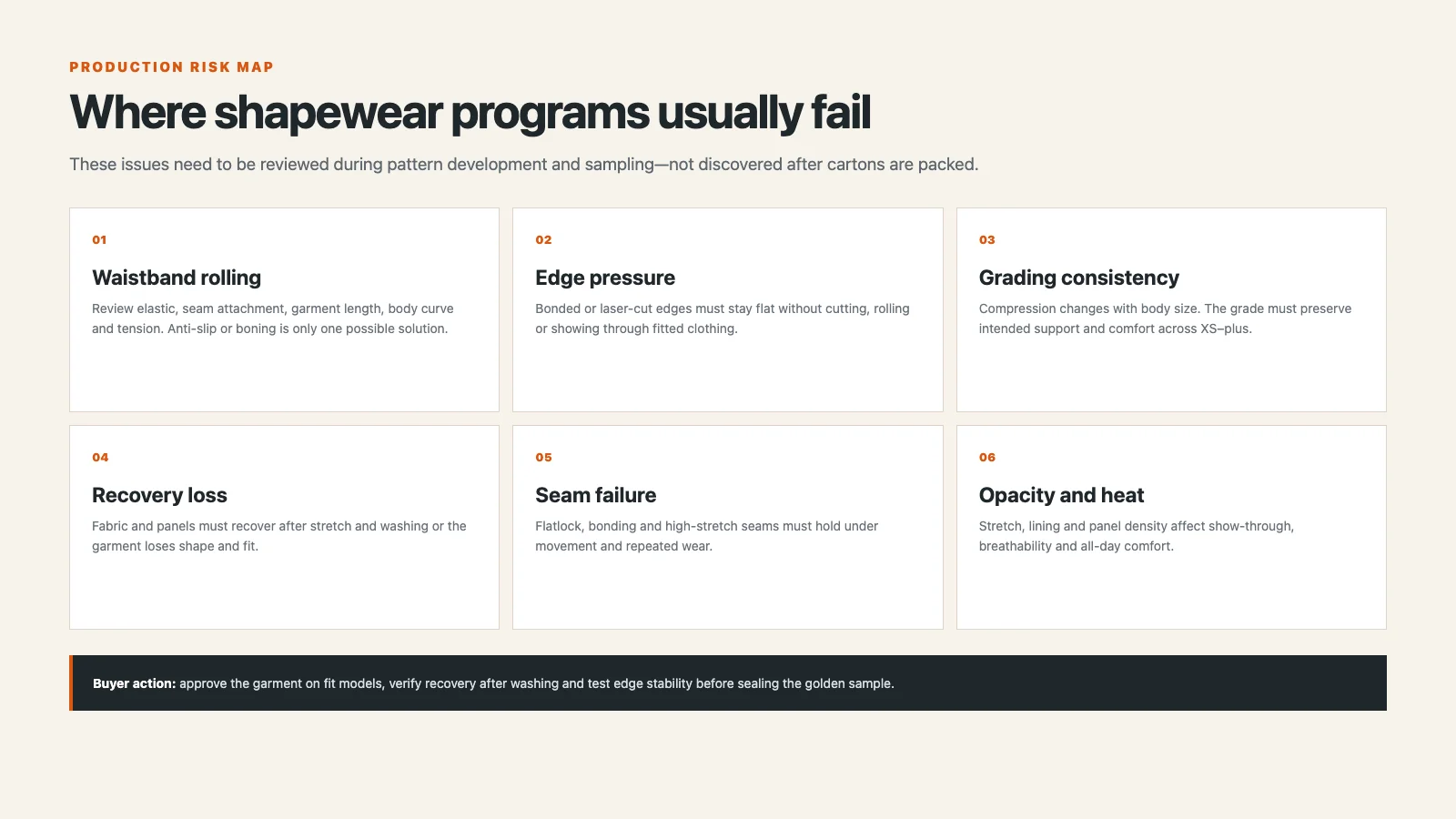
Waistband roll-down
Roll-down can come from elastic recovery, garment length, body curve, seam attachment or insufficient grip. Silicone, boning or a shaped waistband may help, but the right solution depends on the product and wearer.
Edge pressure and visible lines
Bonded, laser-cut or folded edges should stay flat without cutting in. Edge tension, adhesive selection and fabric recovery must be tested as a system.
Seam and bond durability
High-stretch seams and bonded edges are under constant tension. Check seam strength, bonding integrity and appearance after stretching and washing.
Recovery loss
A garment that stretches easily but does not recover loses its shaping function. Recovery should be tested on the exact fabric and finished panel after the care routine.
Opacity and heat
Stretch can reduce opacity and airflow. Test the garment under tension and consider how layering, lining and panel density affect comfort.
6. Soft contour wear needs a different brief from firm shapewear
Soft contour wear sits between everyday underwear, light support and layering pieces. It usually prioritizes hand-feel, comfort and a smooth silhouette over maximum compression.
Use this category for bodysuits, soft-support tops and light-control pieces that can be worn under or as outerwear. The key checks are:
- Softness and breathability of the main fabric
- Light support without hard compression
- Neckline, armhole and bodysuit length through movement
- Opacity and layering performance
- Recovery and shape retention after washing
Do not use the same construction and compression target for both firm shapewear and soft contour products. They serve different customer needs and require different patterns, materials and fit standards.
7. Testing and quality control for shapewear
The approved golden sample should define fit, measurements, fabric, color, panel placement, edge finish and packaging. Bulk inspection should verify the same standard.
MeasurementsFlat and stretched measurements within agreed tolerances.
RecoveryReturn to shape after extension and after the agreed wash routine.
Seams and bondingStrength, appearance and edge integrity under tension.
Fit on bodyComfort and support across representative sizes and movement.
OpacityVisual consistency under stretch and different lighting.
Labels and packingCare text, size, barcode and carton requirements.
Ljvogues uses AQL 2.5 for major defects and AQL 1.0 for critical defects, supported by incoming material checks, inline monitoring and final random inspection. For a deeper review, read our lingerie quality control guide.
8. MOQ, sampling and production planning
Shapewear MOQ depends on whether the style uses an existing construction, a new pattern or custom fabric.
| Route | Typical starting point | Buyer check |
|---|---|---|
| Ready-stock style | From 50 pcs | Available colors, sizes and current construction |
| Custom style | From 300 pcs per style and color | Pattern development, size curve and branding |
| Custom fabric | Usually 500–1,000 pcs depending on the mill and color | Minimum quantity, recovery testing and lead time |
| Stock sample | Usually within 72 hours | Sample availability and freight |
| Custom sample | Usually 7–10 days after tech pack and fabric confirmation | Revision rounds and fit approval route |
| Bulk production | Typically 25–45 days after approval and deposit | Material, capacity, inspection and shipping dates |
For a new shapewear program, the sample stage should include fit models, movement checks, wash recovery and edge stability. A sample that only looks good on a hanger is not enough. See our tech pack guide for the complete development handoff.
FAQ: shapewear and soft contour manufacturing
What is the MOQ for custom shapewear?
Ready-stock styles can start from 50 pcs. Custom styles typically start at 300 pcs per style and color, while custom fabric development usually starts at 500–1,000 pcs depending on the mill and color.
Does higher spandex content always mean better shapewear?
No. Shaping performance depends on fabric modulus, recovery, knit structure, panel geometry and fit. Higher spandex can increase stretch or compression, but it may also affect comfort, opacity and ease of dressing.
How do you prevent waistband roll-down?
We review elastic recovery, waistband construction, garment length, seam attachment and body curve. Depending on the design, a shaped waistband, different elastic, silicone grip or structural support may be appropriate—but it must be tested on fit models.
What is the difference between shapewear and soft contour wear?
Shapewear is designed for stronger compression and shaping. Soft contour wear focuses on light support, comfort and layering. They should use different patterns, materials and fit expectations.
Can you develop shapewear from a reference sample?
Yes. We can review the reference construction, measure it, evaluate the fabric and rebuild the pattern and specification. The buyer should approve fit, compression, recovery and edge comfort on physical samples before production.
Developing a shapewear or soft contour collection?
Share your target silhouette, compression direction, size range, material preference and reference samples. Our team can review the construction and recommend the next step for sampling.
Reviewed by Ocean Yang, Founder & CEO of Ljvogues. This guide reflects current OEM/ODM development practice as of October 2026. Compression, performance claims, MOQ, testing and commercial terms must be confirmed for the exact product and order.

Ocean Yang
Founder & CEO | LjvoguesOcean Yang is the founder and CEO of Ljvogues. He writes about intimate apparel sourcing, material selection, fit development and factory quality control.
Read the full author profile →Related articles

Eco-Friendly Lingerie Manufacturing: Sustainable Materials & OEM/ODM Best Practices
Sustainable lingerie manufacturing guide: compare recycled nylon, organic cotton, OEKO-TEX, GRS/GOTS documentation, durability and OEM/ODM production.
By Ocean Yang - Read article →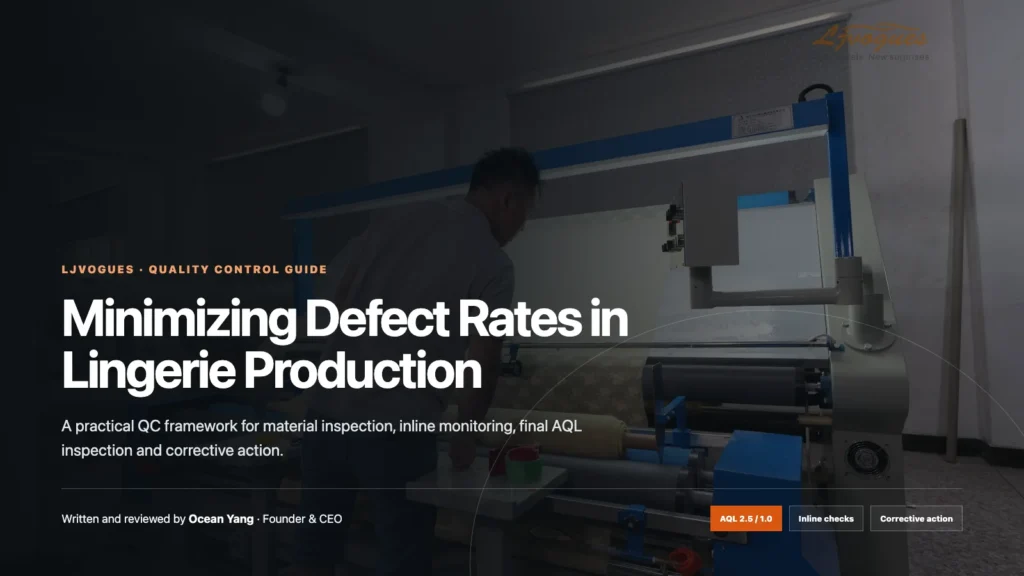
Minimizing Defect Rates in Lingerie Mass Production: A Quality Control Guide
Reduce lingerie production defects with incoming material checks, inline QC, AQL 2.5 inspection, defect classification and corrective action.
By Ocean Yang - Read article →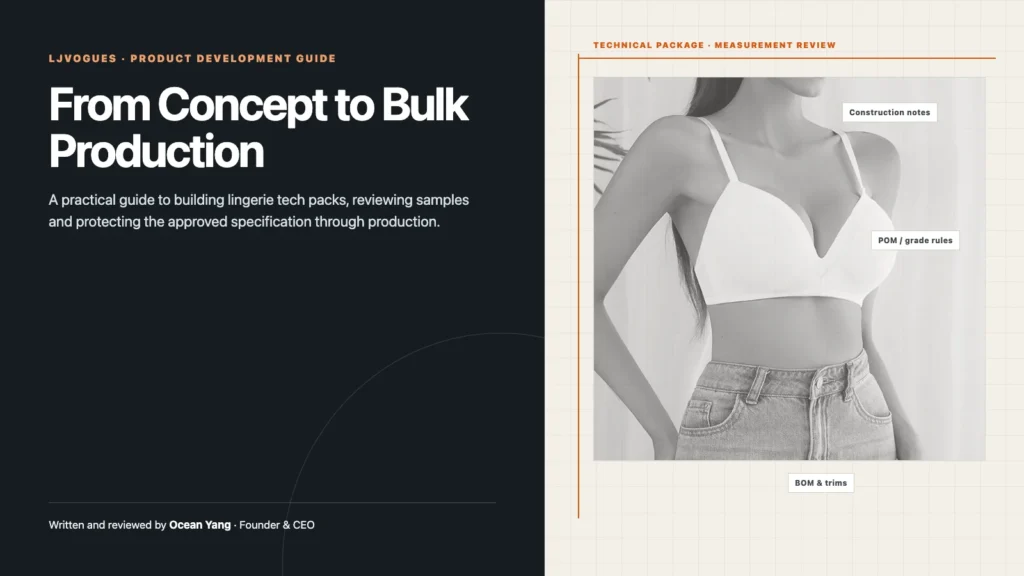
From Concept to Bulk Production: A Complete Guide to Lingerie Tech Packs
Build a production-ready lingerie tech pack: technical flats, BOM, measurements, construction, color standards, sampling feedback and bulk handoff.
By Ocean Yang - Read article →